


Shoulder pain can make everyday movements surprisingly difficult – raising your arm, reaching for something on a shelf, putting on a shirt, sleeping on one side, or even combing your hair can all become uncomfortable.
But shoulder pain is not a single condition.
It can come from the muscles, tendons, joints, surrounding tissues or nerves. Sometimes, pain felt around the shoulder can even originate from the neck.
That is why two people with “shoulder pain” can have completely different symptoms and need completely different treatment.
The first useful question is not “What medicine should I take?”
It is: How does my shoulder pain behave?
What Exactly Is Shoulder Pain?
Shoulder pain is discomfort felt in or around the shoulder. It may develop gradually over time or appear suddenly after an injury, exercise, repetitive activity or an awkward movement.
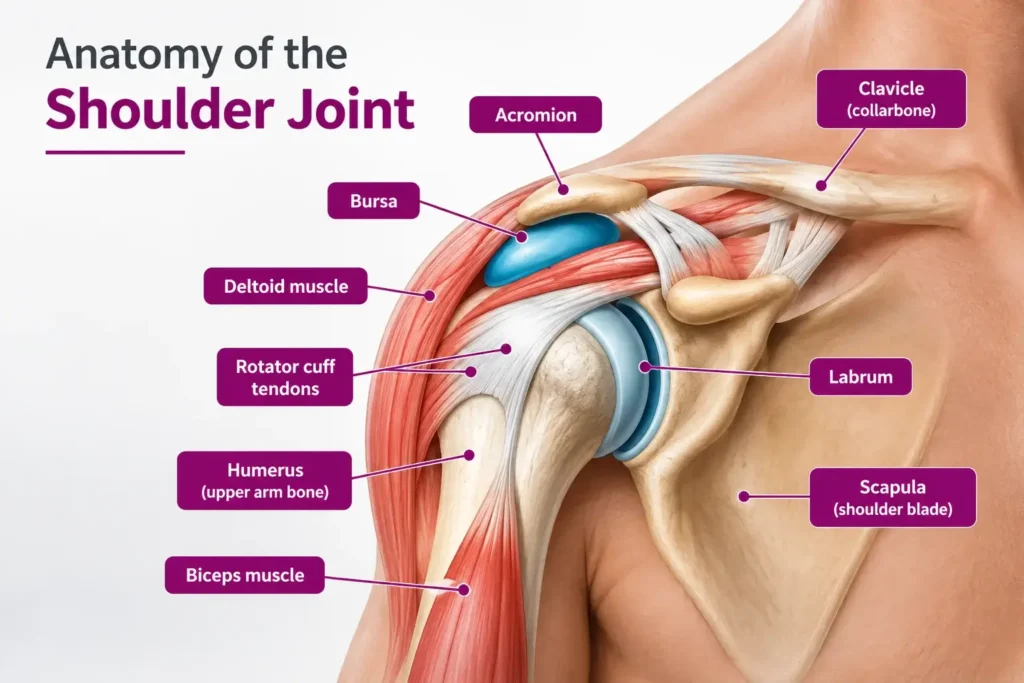
The shoulder is a highly mobile region made up of bones, joints, muscles, tendons, ligaments, and other soft tissues. The rotator cuff—a group of four muscles and their tendons—helps stabilise the shoulder and allows the arm to move.
Because so many structures work together, pain in the shoulder does not automatically tell you which structure is responsible.
Shoulder pain is a symptom, not a diagnosis.
Your Shoulder Pain Pattern Can Tell You Something
Where your shoulder hurts is only one part of the picture.
It is also useful to notice when the pain appears, what makes it worse, what makes it better, whether movement is restricted and whether the pain stays in one place or travels elsewhere.

1) If your shoulder hurts when you raise your arm
Shoulder pain when raising your arm, reaching overhead or performing a particular movement may follow a different pattern from pain that is present all the time.
For example, you may feel comfortable at rest but experience pain when reaching for something on a high shelf.
The important detail is not simply that raising your arm hurts. It is which movement triggers the pain, where you feel it and whether it settles when you stop moving.
2) If your shoulder hurts at night
Some people notice shoulder pain more strongly at night or while lying on the affected side.
Shoulder pain at night can occur with several different shoulder problems, so night pain alone cannot tell you exactly what is causing it.
However, if shoulder pain repeatedly interferes with your sleep, it is worth paying attention to rather than simply ignoring it.
3) If your shoulder feels stiff
Pain and stiffness often occur together, but they are not the same thing.
A shoulder that hurts during a few particular movements is different from one that has gradually become difficult to move in several directions.
When shoulder stiffness and restricted movement become increasingly prominent, conditions such as frozen shoulder may need to be considered.
4) If your shoulder pain travels into your arm
Pain that stays around the shoulder is different from pain that extends down the arm.
If your shoulder pain travels to the arm, particularly when accompanied by tingling, numbness or weakness, the neck or nerves may also need to be considered.
5) If the pain started after exercise
Shoulder pain may appear after starting a new exercise, increasing workout intensity or repeatedly performing the same movement.
In such cases, it is useful to look at what changed rather than simply blaming exercise itself.
Did you suddenly increase the weight? Did you add a new exercise? Did the frequency increase? Did you continue exercising despite pain?
These details can help make the pattern clearer.
6) If the pain keeps coming back
A shoulder problem that settles and then repeatedly returns is also worth understanding.
The question is not simply “How do I make the pain disappear again?” but also “What keeps bringing it back?”
Looking at the activities, movements and situations surrounding each episode may reveal a recurring pattern
Common Causes of Shoulder Pain
There are many possible causes. Some involve the tendons and muscles around the joint, while others involve the joint itself. Pain can also be related to inflammation, injury or nerve irritation.
1) Rotator cuff problems
The rotator cuff is a group of muscles and tendons that helps stabilise and move the shoulder.
Problems involving the rotator cuff can cause pain during certain movements, particularly reaching, lifting or raising the arm. A rotator cuff tear may also cause weakness or difficulty using the arm normally.
2) Shoulder bursitis
A bursa is a small fluid-filled sac that helps reduce friction between moving tissues.
When a bursa becomes irritated, the shoulder may become painful and stiff. Pain can occur with movement and, in some cases, even at rest.
3) Osteoarthritis of the shoulder
Osteoarthritis involves changes to the cartilage and other structures within a joint.
Shoulder osteoarthritis can cause deep aching pain, stiffness and increasing difficulty with movement. Pain often becomes more noticeable with activity.
4) Rheumatoid arthritis and other inflammatory conditions
Rheumatoid arthritis is an autoimmune disease in which the immune system attacks the body’s own joint tissues.
Unlike a problem limited to one shoulder structure, inflammatory arthritis can affect multiple joints and cause pain and stiffness.
5) Frozen shoulder
Frozen shoulder, also called adhesive capsulitis, is different from ordinary shoulder pain. It involves pain along with progressive stiffness and a significant reduction in shoulder movement.
If you notice that everyday movements such as reaching overhead, dressing or putting your hand behind your back are becoming increasingly difficult, frozen shoulder is one possibility that may need to be considered.
6) Neck-related problems
Not every pain felt around the shoulder actually starts in the shoulder.
A problem involving a nerve in the neck, such as cervical radiculopathy, can cause pain or other sensations extending from the neck into the shoulder and arm.
This is particularly important when shoulder pain is accompanied by symptoms such as tingling, numbness or weakness.
7. Injuries
A fall, accident or sudden force can injure the shoulder in several ways.
These include:
- Rotator cuff tears
- Brachial plexus injury
- Shoulder sprains
- Shoulder separation
- Collarbone fractures
- Scapula (shoulder blade) fractures
- Fractures involving the upper arm bone
- Shoulder dislocation
The symptoms depend on the injury. Severe pain, swelling, bruising, deformity or an inability to move the arm after an injury should not be treated as ordinary shoulder pain.
These problems are different from gradual activity-related shoulder pain and may require prompt medical evaluation.
Shoulder Pain vs Frozen Shoulder
Normal shoulder pain: The shoulder hurts, but you can usually still move it. The pain may appear during certain movements—such as raising your arm, reaching overhead or lifting something.
Frozen shoulder: The shoulder hurts and becomes increasingly stiff. You start losing your normal range of movement, making everyday actions like dressing, reaching behind your back or lifting your arm difficult.
The simplest difference:
Normal Shoulder pain = movement hurts.
Frozen shoulder = movement hurts + movement becomes restricted.
A simple comparison:
| Frozen Shoulder | Other Shoulder Pain |
|---|---|
| Pain + increasing stiffness | Pain is usually the main problem |
| Movement becomes restricted | Movement may still be fairly normal |
| Hard to move the arm in several directions | Pain may occur with specific movements |
| Stiffness keeps getting worse | Stiffness may be mild or absent |
The simplest way to remember the difference: With many common shoulder problems, the movement hurts. With frozen shoulder, the shoulder hurts and gradually stops moving normally.
If you’re unsure whether your symptoms fit one pattern or the other, see our detailed guide to normal shoulder pain vs frozen shoulder.
How Is Shoulder Pain Evaluated?
Evaluating shoulder pain usually begins with understanding the story behind it.
A healthcare professional may ask:
- When did the pain begin?
- Did it start suddenly or gradually?
- Was there an injury?
- What movements make it worse?
- Does it hurt when you are resting?
- Is it worse at night?
- Has your shoulder become stiff?
- Is there weakness?
- Does the pain travel into your arm?
- Do you have numbness or tingling?
- Have you experienced a similar problem before?
The shoulder may then be examined for range of movement, strength, tenderness and pain during specific movements.
The neck may also be examined when symptoms extend into the arm or when there are signs that nerves could be involved.
Imaging is not automatically necessary for every case of shoulder pain. Depending on the history and examination, a doctor may or may not recommend an X-ray, ultrasound, MRI or another investigation.
The purpose of evaluation is not simply to put a name to the pain. It is to understand what may be causing it and what type of treatment or further investigation is appropriate.
What Can You Do for Shoulder Pain?
What helps depends on the cause, severity and duration of your shoulder pain.
For mild shoulder pain without concerning symptoms, some simple measures may help.
What helps depends on the cause and severity of your shoulder pain. For mild pain without warning signs:
- Reduce movements that worsen the pain: Temporarily avoid or cut back on activities that repeatedly trigger your pain.
- Keep the shoulder gently moving: Avoid keeping it completely still for long periods, but don’t force painful movements or stretches.
- Try heat or cold: Either may provide temporary relief. Use whichever feels more comfortable for you.
- Consider gentle Ayurvedic oil massage: A gentle massage with a suitable Ayurvedic pain-relief oil may help reduce discomfort and stiffness and make movement more comfortable.
- Check your daily habits: Long hours at a desk, repetitive overhead work, lifting, exercise or sleeping position may be contributing to your pain.
- Don’t push through worsening pain: If an activity consistently makes your shoulder worse, stop pushing through it and reassess what you’re doing.
- Get it checked if it keeps coming back: Persistent, worsening or movement-limiting shoulder pain may need proper evaluation rather than repeated temporary relief.
How Ayurveda Understands Shoulder Pain
Ayurveda looks at shoulder pain as more than a problem in the shoulder itself. During an assessment, an Ayurvedic doctor considers the nature of the pain, stiffness, movement, daily activities, digestion, sleep, and overall health.
What May Be Behind the Pain?
In Ayurveda, Vata imbalance is commonly associated with pain and stiffness. Excessive physical activity, physical strain, an irregular routine, and other factors can increase Vata.
Pitta and Kapha may also play a role, depending on the person’s symptoms and overall condition. An Ayurvedic doctor therefore looks at the complete symptom pattern rather than treating every case of shoulder pain in the same way.
How Does an Ayurvedic Doctor Approach It?
The doctor may assess:
- Where the pain is and how it behaves
- Stiffness and range of movement
- Swelling, tenderness, or weakness
- What makes the pain better or worse
- Lifestyle, physical activity, sleep, and digestion
- The person’s Prakriti and current Dosha imbalance
If needed, an Ayurvedic doctor may also recommend an X-ray or other appropriate investigations to understand the condition better and rule out an underlying structural problem.
Treatment is then selected according to the individual assessment. It may include:
- Snehana (oil application)
- Abhyanga (massage)
- Appropriate exercises
- Dietary and lifestyle changes
- Medicines or other Ayurvedic therapies.
Where Does Agnikarma Fit In?
Agnikarma is a specialised Ayurvedic parasurgical procedure that uses therapeutic heat. Classical Ayurvedic texts describe its use for certain painful conditions involving structures such as Snayu (Ligaments and Tendons), Sandhi (Joints), and Asthi (Bones).
In Ayurvedic clinical practice, Agnikarma may be considered for selected musculoskeletal and joint-related pain conditions. It has also been studied in conditions such as frozen shoulder. However, it is not suitable for every person with shoulder pain. A qualified Ayurvedic doctor should decide whether it is appropriate after assessing the individual.
The aim is not simply to make the pain quieter. An Ayurvedic approach looks at the pain pattern, identifies possible contributing factors, and selects treatment to support better movement, comfort, and everyday function.
When Should You See a Doctor?
Many cases of shoulder pain are not emergencies. But some situations should not be managed indefinitely at home.
You should seek medical assessment if:
- shoulder pain started after a significant fall, accident or injury
- you suddenly cannot move the shoulder normally
- the shoulder appears deformed
- you develop significant or new weakness
- you develop numbness or loss of sensation
- the pain is severe or rapidly worsening
- you develop fever or feel seriously unwell
- your shoulder is becoming progressively stiffer
- pain repeatedly interferes with sleep
- the problem is affecting normal daily activities
- the pain persists or keeps returning without meaningful improvement
If shoulder pain occurs with chest pain, shortness of breath, sweating, nausea or other symptoms that could indicate a heart problem, seek emergency medical attention rather than assuming the pain is coming from the shoulder.
When you’re unsure whether shoulder pain is serious, it is better to have the symptoms assessed than to treating them yourself for an extended period.
Bottom Line
Shoulder pain is a symptom, not a diagnosis.
The most useful clues often come from the way your pain behaves.
Does it hurt when you raise your arm? Is it worse at night? Has your shoulder become progressively stiff? Did it start after exercise or an injury? Does it remain around the shoulder or travel into the arm? Do you have any weakness, numbness or tingling?
These details can help a healthcare professional understand what may be contributing to the problem and whether further evaluation is needed.
And while temporary pain relief can make you feel better, understanding why the pain behaves the way it does is an important part of dealing with recurring shoulder problems.
Your shoulder pain has a pattern. Start by understanding it.
💡 Get Back to Doing What You Love.
Every movement matters. Make your comfort a priority.
