


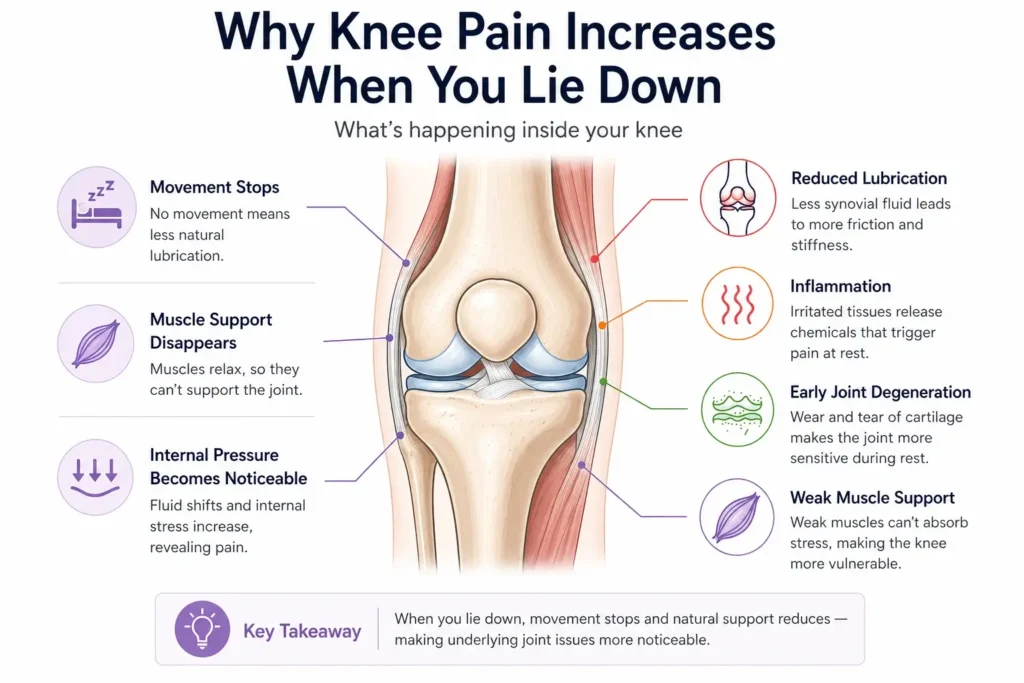
Knee pain when lying down but not while standing usually results from early joint changes, such as reduced lubrication, inflammation, or weak muscle support. When you lie down, movement stops, and these underlying issues become more noticeable.
It feels strange, doesn’t it?
You can walk, stand, even climb stairs — and your knee feels manageable. But the moment you lie down, the pain starts. This pattern isn’t random.
In most cases, it’s an early sign of internal joint imbalance, not just temporary strain. In this article, you’ll understand why it happens — and what you can do about it.
💡 Knee pain starting when you lie down?
This is often an early sign of joint imbalance — not just fatigue.
👉 The earlier you address it, the easier it is to manage.
Why Does Standing Feel Better Than Lying Down?
When you’re standing or moving:
- Muscles around the knee are active
- Blood circulation is higher
- Synovial fluid moves — the natural lubricating fluid inside the joint gets pushed around, nourishing the cartilage
This creates a support system around your knee.
When you lie down:
• Muscles relax completely
• Movement Stops
• Internal pressure patterns change
That’s when underlying issues start showing up.
Research shows that pain at rest or at night is often linked to internal joint degeneration and inflammation, and tends to increase as joint conditions progress. Another study indicates that sleep-related inflammation and reduced movement also make pain more noticeable.
What Is Actually Causing This — The Most Common Reasons
1. Early Cartilage Wear (Beginning of Osteoarthritis)
Cartilage is the soft cushioning between your bones.
Over time (especially after 40):
- This cushioning starts thinning
- Friction inside the joint increases
- Inflammation slowly builds
👉 This stage is called early osteoarthritis
It doesn’t always hurt during activity — but at rest, the discomfort becomes more visible
2. Synovial Fluid Imbalance (Joint Lubrication Issue)
Your knee contains a natural fluid called synovial fluid.
Its functions are:
- Reduce friction
- Help smooth movement
With age or lifestyle:
- This fluid reduces or thickens
- Joint becomes less lubricated
When you lie down, this reduced lubrication causes stiffness and pain
3. Tendon Irritation (Overuse + Micro-Stress)
Tendons connect muscles to bones.
If you:
- Sit for long hours
- Walk unevenly
- Have weak leg muscles
These tendons get irritated over time. This is called tendon irritation
It may not hurt during movement
but becomes noticeable when the body is at rest
4. Bursa Inflammation (Fluid Cushion Swelling)
Inside your knee are small fluid sacs called bursa. They act like shock absorbers.
When irritated:
- They swell slightly
- Pressure builds internally
This condition is called bursitis. It often causes:
- Pain at night
- Pain while lying down
- Local discomfort without heavy activity
What Ayurveda Understood About Nighttime Joint Pain
Before we talk about Ayurveda, let us start with a fact that puts the scale of this problem in perspective.
A peer-reviewed study published on PubMed found that 75% of people with advanced knee osteoarthritis experience nocturnal knee pain, specifically at night and at rest.
A separate international study involving 130 patients across 4 countries found that 81% experienced night pain — and that it was present regardless of the stage of osteoarthritis.
This is not a rare condition. This is the standard experience of millions of Indian families — and Ayurveda described it, named it, and developed a treatment protocol for it thousands of years before any clinical study was conducted.
In Ayurveda, the human body is governed by three fundamental energies called doshas — Vata, Pitta and Kapha. Each dosha controls a specific set of physiological functions.
What is Vata Dosha — explained simply
Vata is the dosha of movement. It governs everything that moves in the body:
- Nerve impulses
- Blood and fluid circulation
- Joint lubrication and movement
- Breathing
- Digestion and elimination
The Charaka Samhita — one of Ayurveda’s two foundational texts — describes Vata in Chikitsa Sthana Chapter 28, the Vatavyadhi Chikitsa chapter, as follows:
“Vata Dosha is the life. It is the strength. It is the sustainer of the body. It holds the body and life together.”
When Vata is balanced, movement flows freely, joints are lubricated, and circulation is strong. When Vata becomes aggravated, the body experiences dryness, stiffness, pain, and degeneration — particularly in the joints.
The six qualities of Vata that explain nighttime knee pain
The Ashtanga Hridayam — the third foundational text of Ayurveda — describes Vata’s qualities as:
- Rooksha (Dryness): Aggravated Vata dries the synovial fluid inside the knee. Less fluid means more friction and more pain — especially during rest, when movement is not replenishing it
- Laghu (Lightness): Vata has no weight or density — it is unstable and erratic. At night, with no grounding activity, it moves freely through the joint space, creating unpredictable, shifting pain patterns
- Sheeta (Coldness): Vata aggravates in cold. Night temperatures fall. Indian winters are especially brutal for this — patients consistently report worse pain in December and January, which is pure Vata aggravation responding to cold
- Khara (Roughness): As Vata dries the joint, cartilage surfaces lose their smoothness. The grinding or grating sensation many elderly patients feel is Khara guna — Vata making smooth surfaces rough
- Sookshma (Minuteness): Vata is subtle enough to penetrate the finest tissue channels in the body. This is why joint pain is deep and difficult to locate precisely — Vata has entered the minutest spaces of the joint structure where no surface product can reach
- Chala (Movement): Vata needs movement to stay balanced. When a person lies still for hours, Vata loses its natural outlet. It becomes agitated and erratic — creating pain that was quiet during the day’s activity
Sandhigata Vata — the exact name Ayurveda gave to this condition
Sandhigata Vata is described in all major Ayurvedic Samhitas. It develops slowly, leading to deformity and loss of function in weight-bearing joints like the knee — and is the most prevalent joint disorder in elderly patients.
Sandhi = joints
Gata = located in
Vata = principle governing movement and lubrication
It means: A condition where aggravated Vata affects the joints.
“The pattern of pain at rest but not during movement is one of the clearest indicators of Sandhigata Vata in my clinical experience. The joint is not broken — it is depleted and cold. Warm oil, gentle movement and consistent care are what it needs. Not stronger painkillers.”
— Dr Bhupesh Vashisht (BAMS, PGDPM)
Co-Formulator, Dr PainQo
What Happens in Sandhigata Vata
When Vata increases in joints:
- Dryness increases
- Lubrication reduces
- Joint tissues weaken
- Friction increases
- Pain becomes prominent during rest
What This Pattern Really Indicates
Clinically, this pattern is often associated with early-stage joint changes or Sandhigata Vata, where the reduced lubrication and internal imbalance make pain more noticeable while resting.
This is the stage where most people ignore it. And later say, “Pain suddenly became worse”
Why Most Solutions Fail
Common products:
- Work on the surface nerves
- Provide temporary cooling or numbing
They don’t address:
- Joint lubrication
- Tissue strength
- Reducing Internal Inflammation
To understand this better, read why pain keeps coming back.
💡 This is exactly where most people get stuck.
They keep trying what feels right — but never address what’s actually causing the pain.
👉 The difference lies in understanding what your joint really needs.
What Actually Works
You need a solution that:
- Works beyond surface sensation
- Reaches deeper tissues
- Increase joint lubrication
- Strengthens muscles
- Boost mobility
- Improves over time
This is exactly why solutions like Dr PainQo focus on deeper support rather than surface-level relief, formulated by Dr Aesha Nanal (BAMS, MD, 19+ years experience)
💡 Choose Care That Goes Deeper
If your pain has started appearing at rest, this is the stage to act.
Not just fast relief.
Not just temporary comfort.
👉 Dr PainQo — where relief meets real healing
FAQs
Knee pain may be serious if it continues for several days without improvement, or if it is accompanied by swelling, redness, warmth, or instability. Pain that occurs even at rest or while lying down often indicates deeper joint changes and should be evaluated rather than ignored.
It may indicate early joint degeneration or inflammation and should not be ignored if it occurs frequently.
It is an Ayurvedic condition where aggravated Vata affects joints, causing dryness, stiffness, and pain — especially at rest.
Gentle movement, proper positioning, heat therapy, and consistent oil massage care help reduce symptoms.
Vitamin deficiencies, such as low levels of Vitamin D, Vitamin B12, and calcium, can contribute to knee pain by affecting bone strength, nerve function, and joint health. However, knee pain is usually caused by a combination of factors, including joint wear, inflammation, and reduced lubrication.
Red flags for knee pain include severe pain after injury, inability to bear weight, sudden swelling, joint locking, or pain accompanied by fever. These symptoms may indicate serious conditions such as ligament damage, infection, or advanced joint issues and require prompt medical attention.
The figure 4 test is a simple physical assessment where you place one ankle over the opposite knee, forming a “4” shape, and gently press the bent knee downward. Pain during this movement may suggest joint or muscle issues, but it is not a definitive diagnostic test.
