

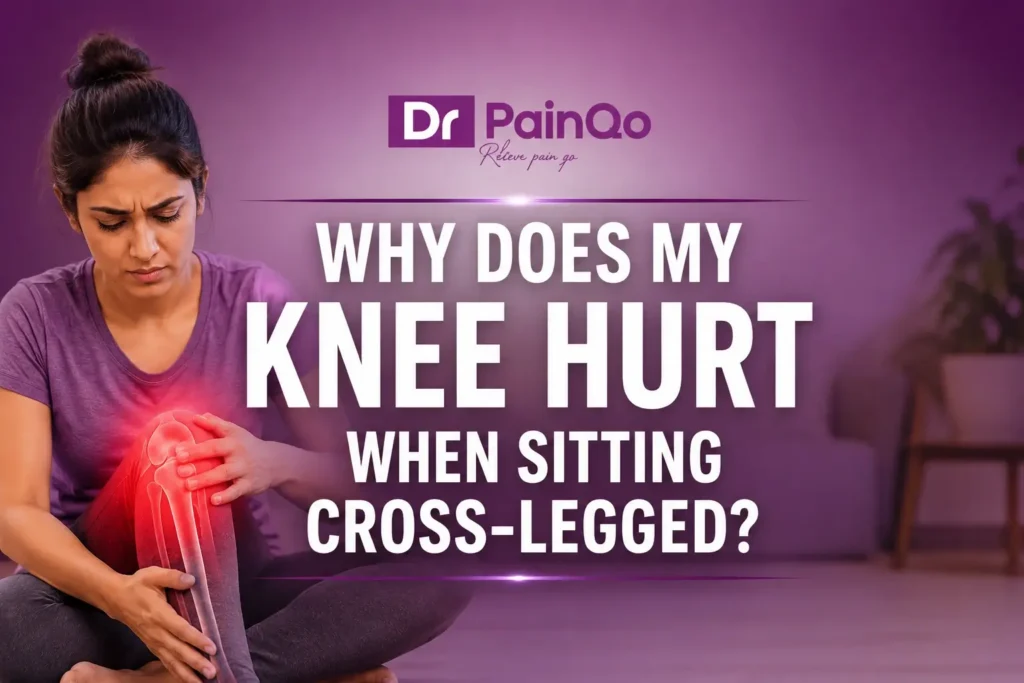
Knee pain while sitting cross-legged usually happens because this posture puts the knee in a deeply folded position, increasing pressure on stiff joints, tight muscles, weak support structures, or early joint degeneration.
You may have noticed something strange: you can walk normally, climb stairs, or stand for long periods, but the moment you sit cross-legged for morning prayers. Or on the floor at a family gathering. Or simply the way you have sat your entire life — cross-legged, naturally.
And then your knee started hurting.
Not a sharp injury. Not from a fall. Just that familiar ache that was not there five years ago — and now seems to get worse every time you fold your legs.
If this sounds familiar, you are not alone. And more importantly — knee pain when sitting cross-legged is not something you simply have to accept. This article explains exactly why it happens, what it means and what you can do about it — written specifically for Indian bodies, Indian habits and the Indian lifestyle where floor sitting is not optional.
💡 Already know you need a better solution?
Dr PainQo is a doctor-formulated Ayurvedic pain-relief oil designed to heal the deep joint tissue behind this kind of pain — not just mask it.
The Truth — Is Cross-Legged Sitting Actually Causing Your Pain?
Most people assume the position itself is the problem. The instinct is to blame the way they are sitting.
But research tells a different story.
A peer-reviewed study published in the Journal of Postgraduate Medicine — the first large-scale study on Indian adults specifically — evaluated 450 participants over 3 years. It found no significant association between cross-legged sitting habits and knee pain in Indians. More than 65% of all participants regularly sat cross-legged.
The sitting position is not the root cause. The sitting position is simply exposing a problem that already exists inside the knee joint.
Think of it like this — if your shoe always pinches a particular spot, the shoe did not create the problem. It revealed that something beneath needed attention. Your cross-legged sitting is doing the same thing.
What Is Actually Happening Inside Your Knee in This Position
When you sit cross-legged, your knee bends and rotates outward simultaneously. This is called external rotation under flexion — and it places a very specific kind of stress on several structures inside the knee at the same time:
• The patella (kneecap) is pressed against the femoral groove behind it — if cartilage has thinned, this causes the characteristic dull ache at the front of the knee
• The medial meniscus (the inner cushion pad) gets compressed — if there is any degeneration or tearing, this position makes it immediately painful
• The inner knee ligaments are placed under rotational stress — tight or weakened ligaments protest loudly in this position
• The synovial fluid in the joint gets displaced — in a depleted or inflamed joint, this causes stiffness and pain
• The hip external rotators are required to do significant work — if they are tight or weak, the knee absorbs the rotation they cannot handle
The knee is often the victim, not the culprit. The real problem may be in your hip, your cartilage, your Vata balance or your joint fluid — not in the act of crossing your legs itself.
5 Most Common Reasons Your Knee Hurts in This Position
1. Early osteoarthritis
Cartilage — the smooth cushioning inside the knee — wears down with age. When you sit cross-legged, the kneecap presses directly against this thinned cartilage. The result is a deep, dull ache that gets worse the longer you hold the position.
The American College of Rheumatology estimates a 40-47% lifetime risk of knee osteoarthritis in adults — and in Indian women, knee difficulties begin on average at age 50, earlier than the global average.
2. Tight hip muscles forcing the knee to absorb rotation
This is the gap every Western article covers — but misses the Indian context. When the hip does not rotate freely enough, the body compensates by twisting the knee. The knee is a hinge joint — it bends and straightens. It is not designed for rotation. When rotation is forced through it, pain follows.
Signs this is your cause:
• Your knees do not comfortably touch or rest near the floor when sitting cross-legged
• You feel the pain on the outer side of the knee, not the front
• You had no issue with this position 5-10 years ago, but flexibility has reduced
3. Sandhigata Vata — the Ayurvedic diagnosis
We covered this condition in depth in our previous article on knee pain when lying down, but not while standing. Sandhigata Vata — aggravated Vata dosha trapped in the joint — causes dryness, roughness and depletion of synovial fluid. In this state, any position that applies pressure to the knee — including cross-legged sitting — becomes painful because the joint lacks its natural lubrication and cushioning.
4. Patellofemoral pain syndrome
The kneecap sits in a groove on the thighbone and should slide smoothly when you move. When it is slightly misaligned — due to weak quadriceps, a tight IT band, or a muscle imbalance — it grinds against the groove instead of gliding. Cross-legged sitting significantly bends the knees, pressing the misaligned kneecap hard against the cartilage beneath it. This causes a sharp or aching pain around or behind the kneecap.
5. Meniscus degeneration
The meniscus is a C-shaped cartilage pad inside the knee that acts as a shock absorber. With age — or past injury — it degenerates or develops small tears. Cross-legged sitting compresses and rotates the inner meniscus. If yours is compromised, you will feel pain specifically on the inner side of the knee in this position — often accompanied by a feeling of tightness or mild swelling.
What Ayurveda Says — Why Sukhasana Is Not Your Enemy
Here is something most Indian families do not know — and no Western article will ever tell you.
The cross-legged sitting position you have used your whole life is called Sukhasana in Ayurvedic and yogic tradition. Sukha means ease or happiness. Asana means posture.
Ayurveda does not consider Sukhasana harmful. It considers it a healing posture — one that grounds Vata, stabilises the hips and promotes internal stillness. The problem in Indian adults over 40 is not the posture. The problem is the depleted joint tissue trying to hold this posture without adequate nourishment.
Ayurveda’s explanation is elegant:
• When joint tissue is healthy — Sukhasana is natural, comfortable, and beneficial
• When Vata is aggravated — the joint becomes dry, rough and depleted. The same posture that was effortless now causes pain because the tissue can no longer handle the demand
• The solution — is not to avoid the position. The solution is to restore the joint tissue to the condition where the posture becomes comfortable again
This is the fundamental difference between the Ayurvedic and Western approaches. Western medicine says — if it hurts, avoid it. Ayurveda says — if it hurts, find out why the tissue is no longer capable and restore it.
As Dr Aesha Nanal explains in our previous article on why pain keeps coming back, surface-level products mask the pain without addressing the tissue degeneration underneath. The Charaka Samhita describes this joint condition under Sandhigata Vata and prescribes warm medicated oils — specifically to restore the oleation (moisture and nourishment) that aggravated Vata has removed from the joint.
Practical Tips for Indians Who Cannot Avoid Floor Sitting
Unlike Western advice that says simply “avoid this position”, in Indian life, that is not realistic. You cannot skip puja. You cannot refuse to sit at a family meal on the floor. You cannot avoid your yoga practice.
Here is what you can actually do:
Before sitting cross-legged:
• Sit on a firm cushion or folded blanket — elevating the hips 3-4 inches above the floor significantly reduces the rotational demand on the knee
• Apply warm Ayurvedic pain relief oil to both knees and massage gently for 2-3 minutes — this activates synovial fluid, warms the joint and reduces the initial compression pain
• Do 5-6 slow seated knee bends before lowering to the floor — this lubricates the joint before placing it under load
While sitting cross-legged:
• Switch which leg is on top every 10-15 minutes — never hold one side for longer
• Place a small cushion under each knee for support — this prevents the knee from being fully unsupported and hanging in rotation
• Lean your back against a wall — this transfers some of the postural load away from the knees
• If pain appears — do not push through it. Come out of the position immediately and gently straighten the leg
After sitting cross-legged:
• Do not stand up suddenly — straighten your legs slowly while still seated
• Gently rotate each ankle 2-3 times in each direction before standing
• Stand up by rolling to one side first — not by pushing directly on the knee
• Apply warm oil again after a long sitting session to clear any built-up inflammation in the joint
The longer-term approach:
• Strengthen your hip external rotators — simple seated hip stretch exercises for 5 minutes daily, gradually reduce the rotation demand transferred to the knee
• Deep breathing in a cross-legged position for even 5 minutes daily is a proven way to gradually retrain the hip-knee relationship — better than avoiding the position entirely
• Consistent use of Ayurvedic medicated oil daily — morning and before bed — progressively nourishes the depleted joint tissue that makes this position painful.
“The patients I see most often are not people who have injured their knee. They are people whose joints have quietly depleted over years — and cross-legged sitting is simply the moment that depletion becomes impossible to ignore. The knee is telling you something important. It is not asking you to stop sitting the way you have always sat. It is asking you to start nourishing it the way you should have been.”
— Dr Aesha Nanal, BAMS MD, MBA (Ayurvedic Pharmacy)
When to See a Doctor Immediately
Most cross-legged knee pain is manageable at home. However, seek medical evaluation without delay if:
• The knee is visibly swollen or warm to the touch
• You feel a clicking, locking or giving way of the knee in this position
• The pain is sharp and sudden — not the familiar dull ache
• You heard or felt a pop the first time the pain appeared
• The pain has been consistently worsening over several weeks with no improvement
• You experience numbness or tingling down the leg when sitting cross-legged
These signs indicate a condition that requires clinical assessment — including imaging — before any home care approach.
💡 Every Day You Wait, the Joint Gets a Little More Depleted.
The good news — you caught it early enough to make a real difference. Consistent Ayurvedic deep healing oil, applied twice daily, progressively restores what age and Vata aggravation have taken from the joint.
Most Dr PainQo users notice meaningful improvement within 14 days. Some notice it sooner.
FAQs
Cross-legged sitting creates simultaneous knee bending and outward rotation — a specific combination that stresses the kneecap, meniscus and inner ligaments. If these structures have early degeneration, this position reveals it while normal walking does not.
Yes — if the pain is mild and dull. Use a cushion under the hips, switch leg positions every 10-15 minutes and apply warm oil before sitting. Stop immediately if pain is sharp, sudden or accompanied by swelling.
Yes — when the root cause is cartilage depletion or Vata aggravation (the most common causes in Indians over 40), consistent twice-daily application of warm Ayurvedic medicated oil replenishes joint nourishment, reduces inflammation and progressively makes the position more comfortable.
Cartilage naturally thins, and synovial fluid volume decreases with age. Vata dosha increases after age 40, causing joint dryness. The position that was effortless at 30, or even in the 40s, becomes painful at 50, not because the position has changed, but because the joint tissue has changed.
No — not by itself. As a large Indian study confirmed, cross-legged sitting is not significantly associated with knee damage in Indians. If underlying joint degeneration exists, the position aggravates it — but avoiding the position without treating the underlying cause does not solve the problem.
Arthritis develops gradually with persistent dull aching and morning stiffness. A meniscus tear causes sudden, sharp pain — usually after a specific twisting movement or injury. Arthritis pain is generalised across the whole knee and hard to pinpoint. Meniscus pain is localised precisely at the joint line — the inner or outer edge of the knee — and often comes with clicking, locking or catching of the joint. Diagnosis requires an X-ray for arthritis and an MRI for a meniscus tear.
A meniscus tear presents as sharp, sudden pain localised to the damaged side of the knee — typically triggered by a bending or twisting action. Swelling occurs near the joint line — on the inner or outer side — and mechanical symptoms like locking or catching of the knee are common. If you heard or felt a pop when the pain first started, get an MRI.
The evidence on Vitamin D for knee pain is inconclusive — multiple randomised controlled trials found no significant reduction in knee pain with Vitamin D supplementation. However, correcting a Vitamin D deficiency — very common in India — supports overall bone and cartilage health. Vitamin C and Vitamin K2 have stronger evidence for joint cartilage support. Get your levels tested before supplementing.
Several studies show that saturated fats trigger tissue inflammation, which directly worsens arthritis. MSG — commonly found in packaged foods, soy sauce and fast food — can trigger two important pathways of chronic inflammation. Sugar triggers the release of inflammatory cells. Salt causes cells to attract water, worsening joint swelling. Refined carbohydrates like white bread have the same inflammatory effect as sugar.
Five main categories to reduce or avoid:
Refined sugar — soft drinks, sweets, packaged biscuits
Refined carbohydrates — white bread, white rice, maida-based foods
Fried and processed foods — trans fats directly worsen joint inflammation
Excess salt and MSG — worsen joint swelling
Red and processed meats — high in inflammatory compounds called AGEs
For topical application — Ayurvedic medicated oils with deep-penetrating botanical compounds are clinically preferred over plain oils for joint pain. Specifically, oils containing Mahavishgarbha Oil base, Ashwagandha and Punarnava have been used in classical Ayurveda for Sandhigata Vata — the condition underlying most Indian knee pain after 40. For cooking, olive oil and mustard oil have the strongest anti-inflammatory evidence for joint health.
Yes — with one important distinction. If the swelling is soft and caused by chronic inflammation or Vata aggravation, warm oil massage is beneficial and recommended. If the swelling is sudden, hard, hot to touch and accompanied by redness, this indicates acute inflammation or possible injury. In this case, do not massage. Apply cold first and see a doctor within 24 hours. Warm oil is for chronic, dull joint pain — not acute injury swelling.
Not necessarily — but it can be. Pain specifically during cross-legged sitting that was not present 3-5 years ago is one of the earliest indicators that cartilage is thinning or synovial fluid is depleting. In Ayurvedic terms, it is one of the first signs of Sandhigata Vata. It does not always mean clinical arthritis — but it does mean the joint is giving you an important signal that it needs nourishment before the condition progresses. Early intervention with consistent Ayurvedic oil application is far more effective than waiting until the pain becomes daily and constant.
