


Every week in my clinic, I see patients who have been living with wrist pain for 6, 12, and even 18 months. Most of them say the same thing: “I thought it was just a sprain. I thought it would go away.”
Sometimes it is a sprain. But often, wrist pain points to something very specific — something that won’t improve without the right understanding.
Let me walk you through what I look for. And what I want you to understand about your own wrist.
Understanding Wrist Anatomy: Why Does the Wrist Hurt?
The wrist connects your hand to your forearm. It allows you to bend, straighten and rotate your hand while supporting activities such as gripping, lifting and writing.
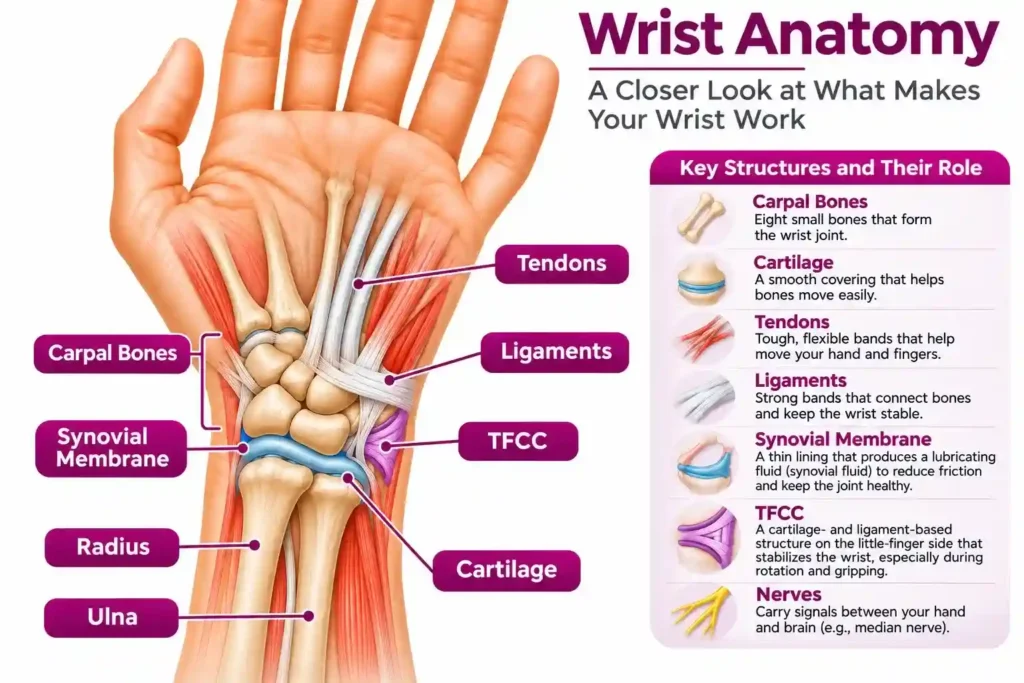
Here are the main structures involved:
| Structure | What it does |
|---|---|
| Carpal bones | Eight small bones that form the wrist |
| Radius and ulna | The two forearm bones that connect with the wrist |
| Cartilage | Provides a smooth surface for joint movement |
| Synovial membrane | Lines certain joints and produces lubricating fluid |
| Tendons | Connect muscles to bones and help move the wrist and fingers |
| Ligaments | Connect 8 carpal bones in alignment and provide joint stability |
| TFCC | Supports the little-finger side of the wrist |
| Nerves | Carry sensations and movement signals between the hand and brain |
Why does this matter? Because wrist pain does not always originate in the joint. It may involve a tendon, ligament or nerve. Identifying the affected structure is an important part of choosing the right treatment.
Before You Read Further — Do These Quick Tests
Each test takes 10 seconds. Each one points to a specific cause.
| Test | How to Do It |
| Phalen’s Test | Press the backs of both hands together (reverse prayer) and hold for 60 seconds. Tingling or numbness in the fingers = likely Carpal Tunnel. |
| Finkelstein Test | Tuck your thumb inside your fist, tilt your wrist outward. Sharp pain on the thumb side = likely De Quervain’s. |
| Ulnar Grind Test | Rotate your forearm slowly (like turning a key). Clicking or pain on the little-finger side of the wrist = possible TFCC issue. |
| Neck Rotation Test | Slowly turn your head left and right. If this reproduces or changes the sensation in your wrist, the problem may be in your neck, not your wrist. |
Where Exactly Does Your Wrist Hurt?
The location of your pain can provide useful clues about its possible cause.
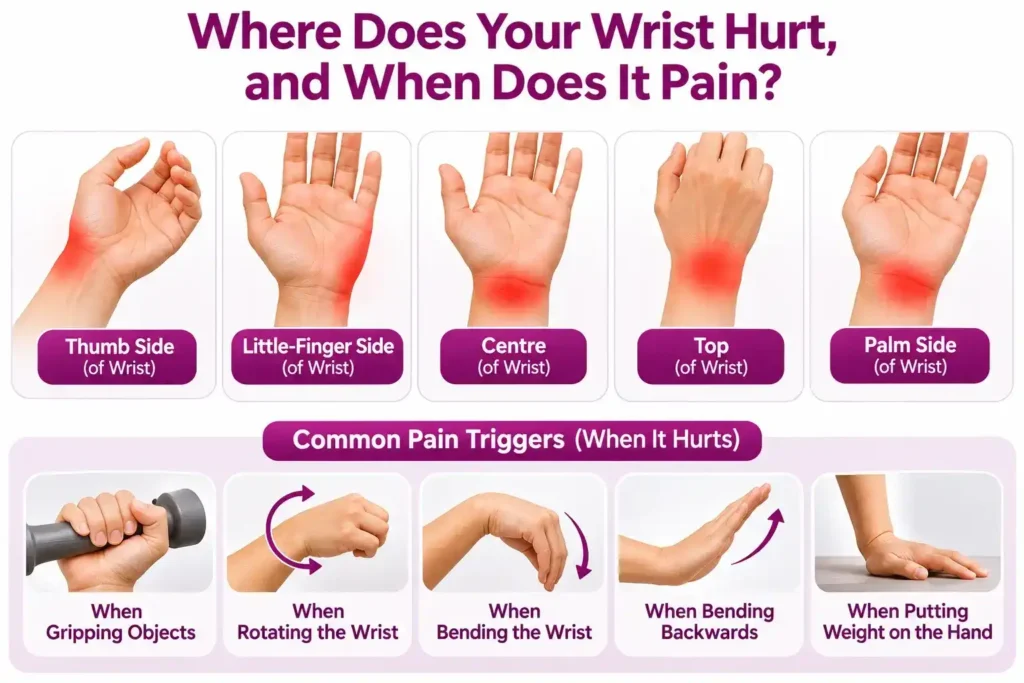
| Pain location | When does it hurt? | Possible causes |
|---|---|---|
| Wrist Pain on Thumb Side | Wrist Pain When Gripping Objects | De Quervain’s tenosynovitis, thumb CMC joint osteoarthritis, tendon irritation or injury |
| Wrist Pain on Little-Finger Side | Wrist Pain When Rotating the Wrist | TFCC injury, ECU tendon irritation, ligament injury |
| Wrist Pain in the Centre | Wrist Pain When Bending the Wrist | Wrist joint irritation, ligament injury, wrist sprain or arthritis |
| Wrist Pain on Top of Wrist | Wrist Pain When Bending the Wrist Backwards | Ganglion cyst, ligament injury, joint irritation or osteoarthritis |
| Wrist Pain on Palm Side | Wrist Pain When Putting Weight on the Hand | Carpal tunnel syndrome, tendon irritation, wrist joint or ligament problems |
| Wrist Pain Near the Wrist Joint | Wrist Pain When Lifting Weights | Wrist sprain, tendon injury, joint irritation or TFCC injury |
| Wrist Pain Around the Wrist Bone | Wrist Pain When Doing Push-Ups | Ligament injury, ganglion cyst, wrist joint irritation or an undiagnosed fracture |
| Wrist Pain Near the Base of the Thumb | Wrist Pain When Making a Fist | Thumb CMC osteoarthritis, De Quervain’s tenosynovitis or tendon irritation |
| Wrist Pain on the Outer Side | Wrist Pain While Typing or Using a Mouse | Tendon overuse, nerve compression or repetitive strain |
| Wrist Pain on the Inner Side | Wrist Pain While Using a Mobile Phone | Tendon irritation, nerve compression or repetitive strain |
These patterns are clues, not a way to diagnose yourself. An examination may be needed to identify the actual cause.
Common Causes of Wrist Joint Pain
1) The TFCC Tear — The Most Commonly Missed Wrist Diagnosis
I want to start here — not because it’s the most common, but because it’s the most commonly missed.
Deep inside your wrist, tucked between your ulna bone and the small bones of the wrist, sits a small cartilage disc called the TFCC — the Triangular Fibrocartilage Complex. It absorbs shock and provides stability for the entire wrist.
How it tears: a fall on an outstretched hand, a sudden twisting force, or years of repetitive loading. Even one powerful wringing motion — like twisting a wet towel — can do it.
Signs that point to a TFCC problem:
- Pain on the little-finger side of the wrist (the ulnar side)
- Worse when you rotate your forearm — turning a doorknob, opening a jar
- A clicking or clunking sensation inside the wrist
- Grip feels weak, unreliable
2) Carpal Tunnel Syndrome — What Everyone Gets Wrong About It
Carpal tunnel Syndrome is famous. But it is widely misunderstood.
The carpal tunnel is a narrow passage in your wrist — like a cable channel. The median nerve runs through it, alongside 9 tendons. When the tunnel swells or narrows, the nerve gets compressed.
Here’s what most people miss: carpal tunnel doesn’t just cause wrist pain. It causes numbness and tingling in the thumb, index, middle, and half of the ring finger. Many people think it’s their fingers that have a problem. It’s the wrist compressing the nerve.
The midnight symptom — the most specific sign of carpal tunnel: waking up at 1 or 2 AM with numb, tingling hands. You shake them to get feeling back. This happens because you sleep with your wrists bent, increasing the pressure on the nerve. If this is happening to you, it is almost certainly carpal tunnel.
Who gets it: pregnant women (fluid retention swells the tunnel), people with thyroid problems, those who do repetitive flexion movements — typists, tailors, assembly line workers.
3) The Ganglion Cyst — That Mysterious Lump on Your Wrist
You notice a soft, round lump on the back of your wrist one day. It wasn’t there before. It doesn’t hurt much, but it worries you.
This is almost certainly a ganglion cyst — a fluid-filled sac that grows from a joint or tendon sheath. It’s completely benign. Your body is leaking synovial fluid (joint lubricant) into a small pocket outside the joint, and it’s pooling there.
Small ones often disappear on their own. Large ones can press on a nerve and cause aching or tingling. They can also shrink and return. The old folk remedy of hitting it with a heavy book is not recommended — that method ruptures it temporarily, but it usually returns.
4) De Quervain’s Tenosynovitis — The One New Mothers Know Too Well
Two tendons on the thumb side of your wrist run through a narrow sheath. When the sheath swells from repetitive pinching, lifting, or baby-holding, every thumb movement becomes painful. The Finkelstein test above confirms it. Full guide coming soon: De Quervain’s Tenosynovitis — causes, treatment and recovery.
5) Wrist OA, Rheumatoid Arthritis and Gout
The wrist is one of the most commonly affected joints in Rheumatoid Arthritis — often alongside the fingers. Warm, puffy, morning-stiff wrists that swell symmetrically on both sides point strongly to RA.
Wrist Osteoarthritis is less common than finger or knee OA, but it does happen — usually in people with old wrist injuries or fractures that never fully healed and slowly wore the joint down over years.
Gout can hit the wrist too, though the fingers and toes are more typical first targets. Sudden severe wrist pain with redness and heat — especially after a heavy meal or alcohol — is worth checking for elevated uric acid.
Wrist osteoarthritis can develop after an old fracture or ligament injury. It is not always simply an age-related problem.
6) Wrist Sprain or Ligament Injury
A “minor sprain” that doesn’t fully heal in 6–8 weeks is not a minor sprain. The scapholunate ligament — which connects two of the 8 carpal bones — is a frequent casualty of falls. If this tears partially or fully, the two bones shift out of alignment, and over time the entire wrist joint degenerates.
If you had a fall months ago and the wrist “never fully felt right,” see a hand specialist. The window for ligament repair is limited.
Wrist Joint Pain vs Tendon Pain vs Nerve Pain
These problems can feel similar, but there are some useful differences.
| Feature | Joint-related pain | Tendon-related pain | Nerve-related symptoms |
|---|---|---|---|
| Main feeling | Deep ache or stiffness | Pain during movement | Tingling, numbness or burning |
| Common trigger | Joint movement or loading | Gripping or repetitive movement | Nerve compression |
| Swelling | Sometimes | Sometimes | Usually not the main symptom |
| Example | Wrist osteoarthritis | De Quervain’s tenosynovitis | Carpal tunnel syndrome |
Remember, symptoms can overlap. A proper examination is needed to distinguish these conditions.
When Wrist Pain Is Actually Coming From Your Neck
The nerves that supply the wrist and hand come from the cervical spine — specifically C6 and C7. When these nerve roots are compressed (from disc problems, cervical spondylosis, or tight neck muscles), the pain travels down the arm and into the wrist and hand.
How to suspect this: wrist pain that comes with neck stiffness, pain that travels from the neck down to the shoulder and arm, or wrist tingling that changes when you move your head.
The neck rotation test above is your first screen. If it reproduces your wrist symptoms, the problem may start much higher than you think. See our Neck Pain pillar guide — many people with wrist pain also have an undiagnosed cervical issue
If your fingers are also affected alongside the wrist — which is common in RA — our Finger Joint Pain guide covers what to look for
What Ayurveda Sees in Wrist Pain
The wrist has three important marma (Vital) points — Manibandha (मणिबंध ) being the primary one. In Ayurveda, marma points are junctions of prana, blood, and nerve energy. When Vata aggravates around Manibandha, the joint loses its natural lubrication and flexibility. What modern medicine calls tendinitis or joint stiffness, Ayurveda often identifies as a Vatavyadhi — a Vata-driven disorder affecting the joint channel.
“What matters most is the type. Dry, creaky, clicking wrists that worsen in cold weather are Sandhivata — the cartilage and fluid channels are running dry. Swollen, warm, tender wrists with morning stiffness are Amavata — there is Ama (inflammatory metabolic waste) lodged in the joint. The same oil protocol that relieves Sandhivata can aggravate Amavata. This is why I always assess the type before recommending treatment.”
— Dr Aesha Nanal, (BAMS, MD, MBA – Ayurvedic Pharmacy), Lead Formulator, Dr PainQo
Sandhivata signs (Vata/dry type): creaking, stiffness, worse in cold, no swelling → responds well to warm oil and heat therapy
Amavata signs (Ama/inflammatory type): puffy, warm wrist, morning stiffness, bilateral → needs internal herbs to clear Ama along with Ayurvedic oil.
Will Dr PainQo Oil Help Your Wrist? Read This First.
“Most oil brands make vague claims for every condition. I won’t do that — because using the wrong treatment delays the right one. Here is my honest answer for each cause of wrist pain.”
— Dr Aesha Nanal
| Condition | Does It Help? | What to Know |
| Wrist OA (Sandhivata) | ✅ Yes | Primary use case. Dry, stiff, creaky joints respond very well to consistent warm oil therapy. |
| De Quervain’s Tenosynovitis | ✅ Yes | Works well in early and mild stages. Warm oil reduces tendon sheath inflammation. |
| Wrist Sprain (recovery phase) | ✅ Yes | After acute swelling has settled, oil helps restore mobility and reduce residual stiffness. |
| Carpal Tunnel (mild) | ✅ Yes — with Ayurvedic medicines | Oil improves circulation and local Vata. Internal Ayurvedic medicines address the nerve compression from within. |
| RA Wrist (Amavata) | ✅ Yes — with Ayurvedic medicines | Oil relieves stiffness and pain. Internal medicines clear Ama, the root cause in Amavata. |
| TFCC Tear | ✅ Yes — with Ayurvedic medicines | Oil reduces surrounding pain and stiffness. Internal medicines support tissue repair alongside medical management. |
| Ganglion Cyst | ❌ No | It is a fluid-filled sac. Oil will not shrink it. Needs observation or aspiration by a doctor. |
| Gout (active attack) | ❌ No | Joint is hot and inflamed. Massage during an attack worsens it. Wait until the flare passes. |
| Referred pain from neck | ❌ No | If the source is C6–C7, oil on the wrist cannot reach the actual problem. Treat the neck. |
| Joint Infection | ❌ No | Medical emergency. Go to a doctor the same day. |
💡 If Your Wrist Pain Falls in the “✅ Yes” Group Above — Start Your Deep-Warmth Protocol.
Give stiff, creaky wrists real botanical warmth instead of temporary surface numbing.
How Is Wrist Joint Pain Diagnosed?
Your doctor will usually begin by asking about your symptoms, activities and any previous injury.
The examination may include checking:
- The exact location of tenderness.
- Wrist movement and flexibility.
- Swelling and visible changes.
- Grip strength.
- Thumb and finger movement.
- Sensation and nerve function.
Depending on the suspected cause, the doctor may recommend:
| Investigation | What it checks |
|---|---|
| X-ray | Fractures, bone alignment and some arthritic changes |
| Ultrasound | Tendons, tendon sheaths and cysts |
| MRI | Ligaments, cartilage and other soft tissues |
| Nerve conduction study | Possible nerve compression |
Not everyone needs a scan. The choice depends on the symptoms and clinical examination.
When Should You See a Doctor?
Please do not ignore wrist pain if you experience:
- Severe pain after a fall or injury.
- Visible deformity or inability to move the wrist.
- Significant swelling or tenderness after trauma.
- A hot, red and swollen wrist, especially with fever.
- New or worsening numbness or weakness.
- Persistent pain that interferes with everyday activities.
If you have tingling or loss of sensation in your hand, get it assessed rather than assuming it is ordinary joint pain.
Frequently Asked Questions
Swelling only appears when there is active inflammation or fluid build-up. Many wrist conditions — TFCC tears, De Quervain’s, nerve compression, ligament stress — cause significant pain without visible swelling. No swelling does not mean nothing is wrong. It often means the problem is structural or nerve-related, not inflammatory.
Tendonitis follows a tendon path — pain is specific, moves with a particular motion (twisting, gripping, pinching), and comes from overuse.
Arthritis is at the joint — morning stiffness, possible swelling at the joint itself, symmetric in RA. Blood tests (CRP, RF, anti-CCP) confirm arthritis. Key clue: if the pain tracks along a line rather than sitting at a joint, it is more likely tendonitis.
Vitamin D — the most common. Causes deep bone aching and joint pain across the body. In India, deficiency is surprisingly widespread despite the climate — dark skin, indoor work, and covered clothing are the reasons.
Vitamin B12 — causes tingling and numbness in the hands, often mistaken for carpal tunnel.
Calcium — weakens bone structure over time, contributing to joint deterioration.
Get these tested before assuming your pain is purely a joint problem.
Push-ups force the wrist into 90° extension under full body weight — a position it was not designed to hold for long. This compresses the carpal bones, loads the TFCC, and strains the wrist extensors. If your wrists hurt in push-ups, switch to fist push-ups (weight on knuckles) or use angled push-up handles. These reduce wrist extension while maintaining the exercise. The underlying cause is usually a tight or irritated TFCC or wrist extensors — worth addressing, not just avoiding.
Twisting (forearm rotation) loads the TFCC — the cartilage disc that sits between your ulna bone and the small wrist bones. It is specifically designed to handle rotation, but when damaged or irritated, every twisting motion — turning a key, opening a jar, wringing a cloth — produces pain. If the pain is on the little-finger side of the wrist during twisting, TFCC involvement is very likely.
Most wrist pain has no single dramatic cause. Common culprits without any injury:
Carpal tunnel syndrome — from repetitive movement, pregnancy, or thyroid problems
De Quervain’s — from daily lifting and pinching over months
Wrist OA — cumulative wear over years
Rheumatoid Arthritis — autoimmune, no injury required
Gout — from elevated uric acid
Referred pain from C6–C7 in the cervical spine.
Vitamin D or B12 deficiency
Honestly — there is no instant fix for structural wrist pain. But for immediate relief:
Stop the aggravating activity for 24–48 hours — do not push through it
Warm medicated oil if the wrist is stiff and dry (not hot or swollen) — massage gently before bathing
Wrist splint to limit movement temporarily and reduce strain overnight
Neutral wrist position during sleep — especially important for carpal tunnel; avoid bending the wrist under your pillow
