

Finger joint pain can make simple activities such as holding a cup, opening a jar, writing or buttoning clothes uncomfortable. It may affect one finger or several fingers, developing gradually or appearing suddenly.
But finger pain does not always mean arthritis. The problem may involve the joint cartilage, its inner lining, tendons, ligaments or even the nerves supplying the fingers.
Understanding which structure is affected, where the pain occurs and when it gets worse can help you understand what might be happening.
1. Understanding Finger Joint Anatomy: What Can Actually Cause Pain?
Your fingers contain several small joints and supporting structures that work together to allow bending, straightening and gripping.
Understanding these structures makes it easier to understand the different causes of finger pain.
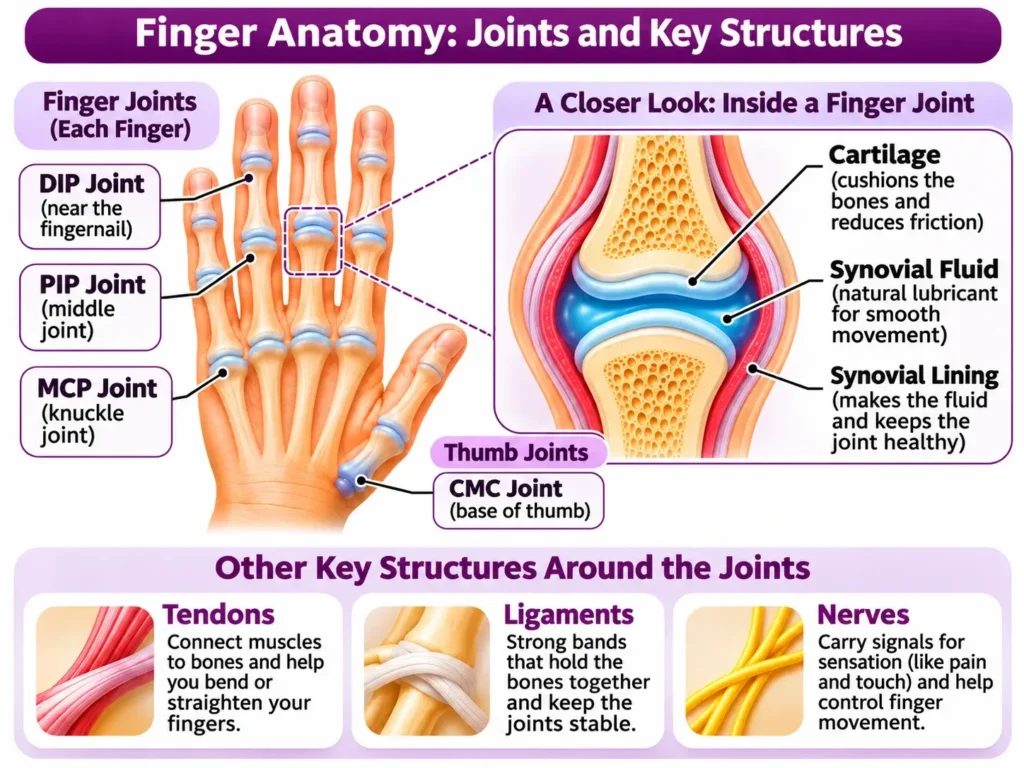
The main finger joints
Each finger, except the thumb, has three joints:
- DIP (Distal Interphalangeal Joint): The joint closest to the fingernail.
- PIP (Proximal Interphalangeal Joint): The middle joint of the finger.
- MCP (Metacarpophalangeal Joint): The knuckle where the finger connects to the palm.
The thumb has two main joints, including the CMC joint at its base, which plays an important role in gripping and pinching.
Other structures that keep your fingers moving
| Structure | What does it do? | How can it cause pain? |
|---|---|---|
| Cartilage | Covers the ends of bones and allows smooth movement | Cartilage damage can cause joint friction and pain |
| Synovial lining | Thin tissue lining the joint that produces lubricating fluid | Inflammation can cause swelling, warmth, stiffness and pain |
| Synovial fluid | Lubricates the joint and reduces friction | Changes associated with joint inflammation can affect comfortable movement |
| Tendons | Connect muscles to bones and help bend or straighten fingers | Irritation or inflammation can cause pain, clicking or difficulty moving |
| Ligaments | Connect bones and stabilise joints | Sprains or tears can cause pain, swelling and joint instability |
| Joint capsule | Surrounds and supports the joint | Inflammation or injury can cause tenderness and restricted movement |
| Nerves | Carry sensation and movement signals | Compression or irritation can cause tingling, numbness or burning sensations |
Why does this matter?
Consider two people experiencing finger pain. One has swelling and stiffness because the joint lining is inflamed. The other experiences clicking and locking because a finger tendon cannot glide smoothly.
Both may describe their problem as finger joint pain, but the underlying conditions and treatments are different.
2. What Does Your Finger Pain Pattern Tell You?
The location, timing and nature of pain can tell you clues about its possible cause.
| Your pain pattern | What it may indicate |
|---|---|
| Finger joint pain in the morning | Inflammatory arthritis or osteoarthritis |
| Finger pain when bending | Joint inflammation, tendon problems or injury |
| Pain when making a fist | Joint changes, swelling or tendon irritation |
| Pain near the fingernail | DIP joint osteoarthritis or injury |
| Pain in middle finger joints | Osteoarthritis or inflammatory arthritis |
| Pain in knuckles | Rheumatoid arthritis, injury or other joint conditions |
| Sudden severe pain with redness and swelling | Gout or joint infection |
| Finger pain with clicking or locking | Trigger finger |
| Pain in several joints of both hands | Possible inflammatory arthritis |
| Finger pain with tingling or numbness | Possible nerve compression |
These patterns are not diagnostic tests. For example, morning stiffness can occur in more than one condition. Its duration, associated swelling and the number of affected joints help doctors interpret it.
3. Common Causes of Finger Joint Pain
A. Osteoarthritis: Gradual Wear and Changes in the Joint
Every joint in your finger has a layer of cartilage between the two bones — smooth, rubbery tissue that stops bone from grinding against bone.
Think of it like the rubber sole of a shoe. It starts thick and cushiony. Decades of bending, gripping, kneading, writing — it wears thin. Once the cushion is gone, the two bones are now closer than they should be. Movement creates friction. That friction creates pain.
Common signs:
- Pain that increases with joint use.
- Stiffness after waking up or remaining inactive.
- Bony enlargement around finger joints.
- Reduced flexibility.
It commonly affects the DIP and PIP joints and the base of the thumb.
B. Rheumatoid Arthritis: When the Immune System Attacks the Joint
Rheumatoid arthritis is an autoimmune disease. The immune system mistakenly attacks the synovial lining, which normally produces fluid to lubricate the joint.
This causes inflammation and swelling. Over time, persistent inflammation can damage cartilage, bone, ligaments and tendons.
Common signs:
- Pain and swelling in multiple joints.
- Morning stiffness that often lasts longer than 30–60 minutes.
- Frequently symmetrical involvement of both hands.
- Warm, tender joints.
- Difficulty making a fist.
Early diagnosis and treatment are important because untreated inflammation can cause permanent joint damage.
C. Gout: When Uric Acid Crystals Collect in a Joint
This one is dramatic, and understanding it properly changes everything.
Your kidneys clear uric acid from your body. When uric acid builds up faster than your kidneys can clear it — from too much red meat, organ meats (kidney, liver), alcohol, or sugary drinks — it starts circulating in the blood. Here’s what most people are never told: at a certain concentration, uric acid crystallises. The crystals are microscopic and needle-shaped. And they deposit inside joints.
Imagine hundreds of tiny needles inside your knuckle, every time the joint moves.
Common signs:
- Sudden, severe joint pain.
- Redness, warmth and swelling.
- Extreme tenderness, sometimes even to light touch.
- Episodes that may develop within hours.
Gout commonly affects the big toe but can also involve finger joints.
D. Psoriatic Arthritis: Joint Inflammation Associated with Psoriasis
Psoriatic arthritis is an inflammatory condition that can affect people with psoriasis, a skin disease.
It may affect the joints, tendons and areas where tendons or ligaments attach to bones.
Common signs:
- Swollen and painful fingers.
- Swelling of an entire finger, sometimes called dactylitis.
- Nail pitting or separation from the nail bed.
- Joint stiffness and pain.
- Associated psoriasis patches in some people.
E. Injuries: Damage to Joint or Supporting Structures
A fall, sudden twist, sports injury or direct impact can damage finger structures.
Depending on the injury, it may involve:
- Ligament sprain or tear.
- Fracture.
- Joint dislocation.
- Tendon injury.
Pain, bruising, swelling and difficulty moving the finger are common. A deformed finger or inability to move it needs prompt medical assessment.
F. Tendon Problems: When Finger Movement Becomes Painful
Tendons connect muscles to bones and allow fingers to bend and straighten.
When a tendon or its surrounding sheath becomes irritated, movement may become painful.
One common example is trigger finger, in which the tendon does not glide smoothly through its surrounding tunnel.
Typical symptoms include clicking, catching or locking when bending or straightening a finger.
4. Why Does Finger Joint Pain Become Worse During Everyday Activities?
Different hand movements place different demands on your joints and supporting structures.
| Everyday activity | Why it may cause discomfort |
|---|---|
| Opening a tight jar | Requires strong gripping and twisting |
| Holding a cup | Places sustained pressure on finger joints |
| Buttoning clothes | Requires precise finger movements |
| Writing | Involves repeated gripping and finger positioning |
| Using a mobile phone | May involve prolonged gripping and repetitive thumb movements |
| Chopping vegetables | Requires repeated gripping and controlled finger movement |
If these activities repeatedly cause pain, the affected structure may need assessment. Avoid assuming that discomfort from mobile use or typing automatically means arthritis.
5. How Is Finger Joint Pain Diagnosed?
A doctor examines the hand to identify the source of pain.
The assessment may include:
- Identifying the exact joints affected.
- Checking swelling, warmth, tenderness and deformity.
- Assessing finger movement and grip.
- Checking for tendon problems and nerve-related symptoms.
- Reviewing medical history, previous injuries and symptom patterns.
Depending on the suspected cause, investigations may include:
| Test | What it helps identify |
|---|---|
| X-ray | Bone changes, joint-space narrowing and fractures |
| Ultrasound | Joint inflammation, fluid and tendon problems |
| Blood tests | Selected inflammatory or autoimmune conditions |
| Joint fluid analysis | Urate crystals or infection |
Not everyone requires all these tests. The doctor selects investigations according to the examination and suspected diagnosis.
6. How Is Finger Joint Pain Treated?
Treatment depends on the underlying condition, severity and functional limitations.
| Condition | Common treatment approaches |
|---|---|
| Osteoarthritis | Joint protection, suitable hand exercises, pain management and selected splints |
| Rheumatoid arthritis | Disease-modifying medicines, specialist care and hand therapy |
| Gout | Medication for acute attacks and urate-lowering treatment when indicated |
| Psoriatic arthritis | Specialist-directed medicines to control inflammation |
| Trigger finger | Activity modification, splinting, injections or procedures |
| Injuries | Appropriate protection, medical assessment and rehabilitation |
| Nerve compression | Treatment directed at the source of nerve compression |
Hand therapy and physiotherapy may help maintain movement, strength and everyday hand function.
7. Ayurvedic Perspective on Finger Joint Pain
Modern medicine asks: “What is wrong with the joint?” It looks at cartilage, bone, and inflammation markers.
Ayurveda asks: “What is the joint being deprived of — or overwhelmed by?” It reads the whole pattern.
Here’s how to understand the difference through two real situations.
Priya’s fingers creak and feel stiff — worse in cold weather, loosening up after she’s been moving around. No swelling. No warmth. Just that dry, grinding, uncomfortable feeling.
Kajal’s fingers are different. They’re puffy, tender, almost warm to the touch. The mornings are worst — 30–40 minutes before the stiffness clears. Even at rest, they ache.
Same complaint — finger joint pain. Completely different things happening inside.
Ayurveda sees Priya as Sandhivata — Vata has dried out the joint’s internal lubrication. Think of a door hinge that hasn’t been oiled in years. It still moves, but it grinds. The fix: warmth and oil, consistently. Sesame-based medicated oil penetrates the tissue, restores moisture, calms the aggravated Vata.
Kajal has Amavata. Here, Ama — incompletely processed metabolic material that Ayurveda identifies as a root cause of inflammation — has circulated through the body and settled in the joint. The joint isn’t just dry — it’s reacting to something that shouldn’t be there. External oil alone doesn’t reach the root cause here. Internal herbs to clear the Ama come first.
The critical insight: treating Priya’s condition and Kajal’s the same way doesn’t work. Warm oil applied to Amavata — an actively inflamed joint with internal Ama — can sometimes worsen it. This is why knowing whether your fingers are dry-and-stiff or swollen-and-warm matters enormously before you choose your treatment.
💡 Still relying on temporary relief for finger joint pain?
Time to rethink your pain-care routine. Try Dr PainQo, crafted to support relief and healing beyond the surface level.
8. When Should You See a Doctor?
Seek prompt medical attention if you experience:
- Sudden severe pain with a hot, red and swollen joint, particularly with fever.
- Severe pain following an injury.
- A visibly deformed finger.
- Inability to bend or straighten the finger.
- New numbness, loss of sensation or changes in finger colour.
Arrange an assessment if pain, stiffness or swelling persists, repeatedly returns or affects everyday activities.
Frequently Asked Questions
Morning stiffness can occur with osteoarthritis and inflammatory arthritis. Prolonged stiffness, particularly with swelling in multiple joints, may indicate an inflammatory condition.
Pain during finger bending may result from:
Joint inflammation or osteoarthritis.
Tendon irritation or inflammation.
Trigger finger, which causes clicking, catching or locking
Yes. While dehydration does not cause arthritis, it reduces the volume of synovial fluid (the joint’s natural lubricant). This increases friction between the cartilage surfaces, causing stiffness and achiness in small joints like those in the fingers. However, there is no clinical evidence for this.
In Osteoarthritis, Stage 1 is characterized by minor cartilage softening, slight narrowing of the joint space, and the beginning of bone spur (osteophyte) formation at the joint edges. You may experience only mild, intermittent stiffness, often dismissed as “normal ageing.”
Pain during gripping is often caused by mechanical stress at the CMC (thumb base) joint or the PIP (middle knuckle) joints. It suggests cartilage wear (Osteoarthritis) or tendonitis, as gripping multiplies the force exerted on these small structures.
