


Neck pain can make everyday activities uncomfortable. Turning your head, working at a desk, driving or getting comfortable in bed may become difficult.
Sometimes, neck pain develops after muscle strain or spending too long in one position. In other cases, it may be related to age-related changes in the cervical spine, a disc problem or irritation of a nerve.
Neck pain can affect one side or both sides of the neck. It may also spread towards the shoulders, arms or upper back, depending on the underlying cause.
Either way, this guide will help you understand why it’s happening — and what you can actually do about it.
How Common Is Neck Pain?
Neck pain is a significant health concern worldwide. A Global Burden of Disease study estimated that approximately 203 million people worldwide experienced neck pain in 2020. This is a global estimate, not an India-specific figure. Read the published research on the global burden of neck pain.
Reliable estimates specifically for the number of Indians experiencing neck pain can vary according to the population studied, the definition of neck pain and the period measured. Therefore, a global figure should not be presented as the number of people affected in India.
The Complete Anatomy of the Cervical Spine
To understand why your neck hurts, you must understand how the neck is built to function. The cervical spine consists of the top seven vertebrae (C1 through C7), which support the skull, facilitate a wide range of motion (rotation, flexion, extension, and lateral bending), and protect the vital spinal cord as it travels from the brain down to the body.
How Lever-Arm Mechanics Stress the Neck
Your head is a heavy structure—weighing approximately 10 to 12 pounds when held in a neutral, upright posture directly over your spine. However, the cervical spine operates on a mechanical lever system.
When you tilt your head forward to look at a smartphone or a poorly positioned laptop screen, the effective gravitational weight experienced by your cervical vertebrae increases exponentially:
- 15-Degree Forward Tilt: ~27 pounds of effective pressure on the cervical discs.
- 30-Degree Forward Tilt: ~40 pounds of effective pressure.
- 45-Degree Forward Tilt: ~49 pounds of effective pressure.
Over thousands of hours of desk work and digital device usage, this constant mechanical overload compresses the intervertebral discs, strains the facet joints, and forces the supportive neck muscles (particularly the trapezius and levator scapulae) into a state of chronic, protective hyper-contraction.
What Is Your Neck Actually Made Of?
Before we get into causes and treatments, it helps to understand what’s inside your neck. Most neck pain has a specific source — a disc, a muscle, a nerve, a joint. Knowing what each part does makes it much easier to understand why things go wrong.
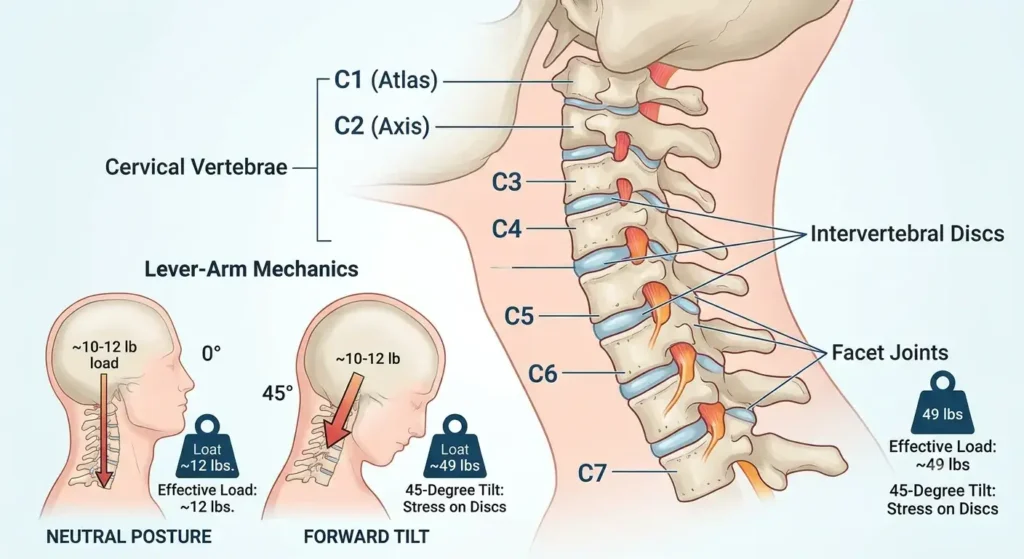
Your neck is a remarkably compact structure that does an enormous job: it holds up your head, allows it to move in almost every direction, and protects the spinal cord — the main cable carrying signals between your brain and the rest of your body.
| Name of Part | Explanation | What Goes Wrong |
| Cervical Vertebrae (C1–C7) | 7 bones stacked in the neck. They support the skull and allow movement. | Bony spurs form with age, narrowing spaces around nerves. Joints become arthritic. |
| Intervertebral Discs | Cushions between each vertebra that absorb shock and allow bending — like a jam doughnut: tough outside, soft gel inside. | Dry out with age. Gel can push through the outer ring (slipped disc), pressing on a nerve and causing arm pain. |
| Facet Joints | Small joints at the back of each vertebra that guide bending and rotation. Two at every level. | Become inflamed or arthritic. Causes a localised ache that worsens when tilting the head back. |
| Muscles | Multiple layers that move the head and hold it upright all day — from large surface muscles to deep stabilisers near the spine. | Strain, spasm, and tight knots (trigger points) can develop. The source of most everyday neck pain. |
| Nerves | 8 pairs of nerve roots exit the spine at each level and control sensation and movement in the arms and hands. | Compression causes a pinched nerve — burning or shooting pain down the arm, numbness, and tingling in fingers. |
| Ligaments | Fibrous bands that connect bone to bone, keeping the vertebrae aligned and limiting excess movement. | Sprained or torn in whiplash or trauma. Heal slowly and can leave the joint unstable. |
Different Neck Pain Patterns You Should Know About
Pay attention to when the pain begins, what makes it worse and whether other symptoms occur. This information can help a healthcare professional assess the problem.
Neck pain can feel different depending on its cause, location, and severity. Noticing when the pain starts, what makes it worse, and whether it spreads to other areas can help you decide what to do next.
| Pattern | Likely cause | What to do first? |
|---|---|---|
| Neck pain after waking up | Poor sleeping position, pillow issues, or stiffness | Try gentle movement, a supportive pillow, and a warm compress. |
| Neck pain while turning the head | Muscle strain, stiffness, or irritation of the joints in the neck | Avoid forcing the movement; try gentle movements within a comfortable range |
| Neck pain after using a mobile phone or working at a desk | Prolonged screen use, poor posture, or muscle tension | Raise your screen closer to eye level, take regular movement breaks |
| Neck pain spreading to the shoulder or arm | A possible pinched nerve, cervical disc problem | Seek assessment if you have tingling, numbness, or weakness. |
| Pain mainly on the left side or right side of the neck | Muscle strain, sleeping position, or irritation of the neck joints; the side alone cannot identify the cause | Notice whether movement or posture triggers the pain and try gentle self-care if symptoms are mild. |
| Pain mainly on the right side of the neck | Muscle strain, sleeping position, or irritation of the neck joints; the side alone cannot identify the cause | Avoid repeatedly straining the neck, adjust your posture, and seek medical advice if the pain persists or worsens. |
| Neck pain after a sudden jerk, fall, or road accident | Possible whiplash or another neck injury | Seek prompt medical advice after significant trauma. |
| Neck stiffness with pain that keeps returning | Repeated strain, cervical spondylosis, or osteoarthritis | Review daily habits and seek assessment if pain keeps returning. |
What Are the Common Causes of Neck Pain?
Neck pain can develop suddenly or gradually. Common causes include muscle strain, daily habits, injuries and conditions affecting the cervical spine.
1. Muscle Strain and Tension
Muscle strain is a common reason for neck discomfort.
It may happen when you:
- Keep your head in the same position for a long time.
- Make a sudden or awkward neck movement.
- Spend long periods working without movement breaks.
- Carry heavy items in a way that puts extra strain on the neck and shoulders.
The muscles may become sore, tight or tender, making neck movement uncomfortable.
2. Poor Posture and Prolonged Sitting
Sitting with your head pushed forward or shoulders rounded for long periods can increase the load on your neck muscles.
This may happen during desk work, reading or other activities that involve remaining in one position.
The goal is not to maintain a rigid posture all day. Instead, vary your position regularly and avoid staying still for too long.
3. An Unsuitable Pillow or Sleeping Position
A pillow that does not support your head and neck comfortably may contribute to stiffness or muscle discomfort after sleeping.
Sleeping with the neck held at an awkward angle for a prolonged period may also aggravate symptoms.
However, a particular pillow is not necessarily the cause of every episode of morning neck pain. Persistent or recurring symptoms may have other explanations.
4. Direct Cold Air From an Air Conditioner
Some people notice increased neck tightness or discomfort when cold air from an air conditioner blows directly onto them for long periods.
Cold exposure may contribute to muscle discomfort in some individuals, but direct air from an AC is not an established cause of cervical disc damage, osteoarthritis or nerve compression.
If you notice a consistent connection, try redirecting the airflow and keeping the neck comfortable. Seek medical advice if the pain persists or worsens.
5. Carrying a Heavy Bag on One Shoulder
Carrying a heavy handbag, laptop bag or backpack on one shoulder can increase the load on the muscles around that shoulder and the neck.
This may contribute to muscle fatigue, tightness or discomfort, particularly when the load is heavy or carried for long periods.
Consider reducing the bag’s weight, switching shoulders when appropriate or using a well-fitted backpack with both shoulder straps.
6. Cervical Spondylosis and Osteoarthritis
Cervical spondylosis refers to age-related changes in the discs, bones and joints of the neck.
Osteoarthritis involves changes in the joints, including the gradual breakdown of cartilage that normally helps joint surfaces move smoothly.
These changes can occur as people age, but they do not always cause symptoms.
When symptoms develop, they may include:
- Neck pain or stiffness.
- Reduced range of movement.
- Discomfort with certain movements.
- Headaches in some cases.
A medical assessment can help determine whether these changes are responsible for the symptoms.
7. Spinal Stenosis
Spinal stenosis occurs when spaces within the spine become narrower. In the neck, this narrowing may place pressure on the spinal cord or nearby nerves.
Possible symptoms include neck discomfort, arm symptoms, weakness, numbness or problems with balance and coordination.
Symptoms depend on the location and severity of the narrowing. New or progressive weakness, difficulty walking or loss of coordination requires prompt medical assessment.
8. A Pinched Nerve
A pinched nerve occurs when a nerve is compressed or irritated. In the neck, this may happen because of a disc problem or changes in the surrounding bones and joints.
Possible symptoms include:
- Pain travelling from the neck into the shoulder or arm.
- Tingling or numbness.
- Weakness in some muscles.
Not all pain spreading into the shoulder or arm is caused by a pinched nerve. A clinician can assess the symptoms and determine whether further investigation is needed.
9. Whiplash and Other Neck Injuries
Whiplash is an injury commonly associated with a sudden back-and-forth movement of the neck, such as during a road traffic collision.
Symptoms may include:
- Neck pain and stiffness.
- Reduced neck movement.
- Headaches.
- Shoulder discomfort.
Symptoms may not appear immediately after an injury. If neck pain follows a significant accident, seek medical assessment rather than assuming it is ordinary muscle soreness.
10. Other Medical Conditions
Less commonly, neck pain may be associated with inflammatory conditions, infections or other medical problems.
Persistent pain, unexplained symptoms or pain accompanied by fever or neurological changes should be evaluated rather than managed with home remedies alone.
Common Symptoms of Neck Pain
Neck pain can feel different from person to person. Its location, intensity and associated symptoms may provide useful clues, but they cannot establish a diagnosis on their own.
Common symptoms include:
- Aching or soreness: Discomfort around the back or sides of the neck.
- Stiffness: Difficulty moving the neck comfortably.
- Muscle tightness: A feeling of tension around the neck and upper shoulders.
- Reduced movement: Difficulty looking up, down or to either side.
- Headaches: Some neck conditions can be associated with headaches.
- Pain spreading beyond the neck: Discomfort may extend towards the shoulder or arm.
- Tingling, numbness or weakness: These may indicate nerve involvement and need appropriate assessment.
The Ayurvedic Science: Understanding Griva Stambha
While modern medicine views neck pain through the lens of biomechanics and inflammation, classical Ayurveda provides a deeper, systemic framework through the concept of Doshas—specifically Vata Dosha, which governs all movement, circulation, and nervous system signalling in the body.
In Ayurvedic texts, neck stiffness and cervical rigidity are classified under Griva Stambha.
The Mechanism of Vata-Driven Joint Dryness
- The Qualities of Vata: Vata is characterized by properties that are dry (Ruksha), cold (Sheeta), and light/mobile (Laghu).
- The Impact of Age and Environment: As we cross the age of 40, or when we spend hours in air-conditioned environments exposed to drafts and immobility, Vata naturally accumulates in the upper body.
- Synovial Depletion (Rukshata): This excess Vata dries out the micro-lubrication (comparable to synovial fluid and tissue hydration) between the cervical vertebrae and surrounding muscle sheaths.
- The Resulting Spasm: When tissues lose their natural unctuousness and warmth, they become brittle and stiff (Stambha). The surrounding muscles lock down to stabilize the dry, friction-prone joints, creating the classic tight neck knot.
The Principle of Reverse Properties (Hetu-Vipareeta)
Ayurveda operates on a fundamental law of healing:
“Whatever quality is causing your pain, you heal it with its exact opposite.”
If a problem is built on coldness and dryness, adding more coldness will only make it worse. This is why trying to fix a stiff, frozen neck with icy cooling sprays or aerosol gels often backfires. While cold sprays temporarily numb the surface nerves, they send a wave of coldness deep into tissues that are already starved of circulation, causing micro-blood vessels to shrink and tight muscles to lock up even further once the numbing wears off.
To truly melt away neck stiffness and bring back smooth movement, you must treat cold, dry muscle fibers with their direct biological opposites:
- Warmth (Ushna): Opens up tight blood vessels, floods the area with fresh oxygen, and washes away accumulated muscle tension.
- Moisture & Nourishment (Snigdha): Sinks deep beneath the skin to lubricate dry, friction-prone muscle sheaths and joints.
- Deep Absorption (Sukshma): Carries natural healing herbs straight into the tight muscle knots where the pain actually lives.
The Classical Ayurvedic Oil Protocol
Applying a warm, lipid-based Ayurvedic oil is one of the most effective, time-tested methods to relieve cervical stiffness. Lipid carriers pass through the skin’s epidermal barrier, carrying active phytoconstituents directly to spasmed muscle fibers and nerve endings.
The Ingredient Synergy Breakdown:
1. The Deep-Penetrating Carriers (The Vehicles)
- Erand Taila (Castor Oil): Castor oil (Erand) is classically prized in Ayurveda as Vata-Hara (the ultimate Vata destroyer) due to its heavy, deeply warming nature and ricinoleic acid content.
- Til Taila (Sesame Oil Base): Combined with Castor oil, these carrier lipids act as a natural transdermal delivery system, carrying the active botanicals through dermal layers directly into rigid muscle sheaths.
2. The Neuromuscular & Nerve-Calming Complex
- Ashwagandha & Bala (Sida cordifolia): Both are powerful Brumhana (nourishing/strengthening) herbs. While Ashwagandha calms hyper-excitable nerves, Bala literally means “strength”—it rebuilds weakened cervical tissues and restores resilience to overstretched trapezius fibers.
- Maha Vishgarbha Oil: A legendary classical Ayurvedic oil formulation specifically engineered for severe, chronic Vata disorders, deep-seated muscle rigidity, and radiating nerve irritation (Cervical Radiculopathy).
3. The Circulation & Pain-Relieving Drivers
- Nirgundi (Vitex negundo) & Clove Oil (Lavang): Nirgundi is one of the most potent botanical anti-inflammatories in Ayurveda, recognized for easing joint stiffness and localized swelling. Clove Oil contains natural eugenol, which offers immediate local soothing and warmth without freezing or shocking the tissue.
- Ajwain (Carrom Seeds): Ajwain provides powerful Deepana/Pachana (digestive/clearing) qualities at the local tissue level, clearing accumulated Ama (metabolic waste/lactic acid) from spasmed muscles.
- Vacha (Acorus calamus): Vacha acts as a neurological stimulant that opens up blocked circulatory channels (Srotas) and enhances local sensitivity and blood flow.
“Most of the neck pain cases I see in clinic have a strong Vata component. The patients often describe their pain as shifting, sharp, and worse in cold weather or after stress. Warming oils and internal herbs work very differently from just taking a painkiller — they actually reduce the recurrence over time.”
— Dr Aesha Nanal, Ayurvedic Physician & Lead Formulator, Dr PainQo
💡 Ready to Melt Away Neck Stiffness?
Dr PainQo Pain Relief Oil brings this exact Ayurvedic protocol to life in one easy daily formula.
How Is Neck Pain Diagnosed?
A healthcare professional will usually begin by asking about your symptoms and examining your neck.
The assessment may include:
- When the pain started and how it has changed.
- Whether an injury or particular activity preceded it.
- Which movements increase or reduce the discomfort.
- Whether pain spreads to the shoulder, arm or hand.
- Checks of neck movement, muscle strength, sensation and reflexes, when appropriate.
Imaging tests are not necessary for every case of neck pain. Depending on the findings, medical history and suspected cause, a clinician may recommend an X-ray, MRI or another investigation.
The purpose is to identify the likely cause and determine which treatment, if any, is appropriate.
How Is Neck Pain Treated?
Treatment depends on the underlying cause, severity and symptoms. Common treatment approaches include:
1. Conservative Management
For uncomplicated muscular neck pain, initial treatment usually focuses on maintaining gentle movement, modifying aggravating activities and avoiding prolonged bed rest.
2. Heat Therapy
Warm compresses or heating pads may help ease muscle tightness and stiffness. Cold packs may be useful for some people, particularly after an acute strain.
3. Physiotherapy and Exercises
Physiotherapy may include:
- Gentle neck mobility exercises.
- Stretching of tight neck and shoulder muscles.
- Strengthening exercises for neck and upper-back muscles.
- Posture and movement training.
Exercises should be selected according to the underlying condition.
4. Medication
Depending on the diagnosis, a doctor may recommend pain relievers or anti-inflammatory medicines. In selected cases, other medications may be considered for nerve-related pain or muscle spasms.
5. Treatment for Cervical Spine Conditions
When pain is associated with cervical spondylosis, a herniated disc or nerve compression, treatment may involve targeted physiotherapy, medication and further specialist evaluation. Surgery is considered only in selected cases, such as significant or progressive neurological problems or persistent symptoms despite appropriate treatment.
6. Identify and Address the Underlying Cause
Recurring or persistent neck pain needs proper assessment. Depending on the symptoms, a doctor may recommend a physical examination and, when indicated, imaging or other investigations.
Can Neck Pain Be Prevented?
While age-related spinal changes occur naturally, daily posture and dietary habits determine whether your neck remains supple or prone to chronic stiffness. Preventive care relies on reducing structural mechanical stress and avoiding internal Vata triggers:
1. What to Avoid in Your Diet (Ahara)
Ayurveda teaches that chronic joint stiffness begins in the gut. Foods that are cold, dry, or light aggravate Vata Dosha, depleting the body’s natural joint lubrication (Sleshaka Kapha) and making neck muscles prone to spasms.
- Cold & Raw Foods: Avoid excess raw salads, iced drinks, and frozen meals, which reduce digestive fire (Agni) and increase tissue coldness.
- Dry & Crispy Snacks: Limit packaged crackers, chips, popcorn, and dry cereals that absorb internal moisture and promote tissue dryness (Rukshata).
- Excessive Dehydrating Beverages: Cut down on excess caffeine (coffee, black tea, energy drinks) and alcohol, which constrict micro-blood vessels and dry out connective tissues.
- Vata-Aggravating Legumes: Limit un-soaked heavy lentils or dry beans (like chickpeas and kidney beans) if they cause gas or bloating, as internal systemic gas accelerates Vata-driven pain.
2. Daily Habits & Ergonomics (Vihara)
- Optimize Desk Ergonomics: Keep your monitor at eye level and sit with shoulders relaxed, elbows bent at 90 degrees, and feet flat on the floor.
- Practice Micro-Breaks: Avoid remaining in a fixed position for longer than 30–45 minutes. Simple posture resets—like shoulder rolls and gentle side-to-side neck tilts—keep muscle fibers flexible.
- Support Spinal Alignment Overnight: Use a medium-firm ergonomic pillow that supports the natural arch of your neck without tilting your head forward or sideways.
- Protect Against Cold Drafts: Avoid sleeping directly under cold air-conditioner vents or fans directed at your head and neck, as cold air contracts muscle fibers and stiffens joints.
When Should You See a Doctor for Neck Pain?
Most neck pain from muscle strain or poor posture improves on its own within 1–2 weeks with rest and basic self-care. You don’t need to rush to a doctor for every stiff neck.
But see a doctor if you have:
- Pain that radiates into your shoulder, arm, or hand
- Numbness or tingling in your fingers
- Weakness in your arm or hand
- Clumsiness in your hands or difficulty with fine movements like writing or buttoning a shirt
- Balance problems or difficulty walking alongside neck pain
- Pain that started after a fall, accident, or sudden impact
- Pain that does not improve after 2–3 weeks of self-care
- Severe pain that wakes you from sleep
- Any bladder or bowel changes alongside neck pain — this is rare but needs immediate attention
Do not wait and hope that radiating arm pain, hand weakness, or balance problems will resolve on their own. These patterns suggest nerve or spinal cord involvement, and the longer they continue, the harder they are to fully reverse.
Frequently Asked Questions About Neck Pain
To relieve neck pain fast at home, apply a warm, deep-penetrating Ayurvedic pain oil containing Vata-pacifying herbs like Boswellia (Shallaki), Ashwagandha, and Nirgundi to expand blood flow and relax spasmed trapezius muscles. Follow with a warm, damp towel compress for 5 minutes and perform gentle chin tucks to relieve pressure on the cervical spine.
For chronic neck stiffness and desk posture strain, heat and warming oils are significantly more effective than ice. While ice is reserved for acute trauma within the first 24 hours to manage swelling, applying extreme cold to chronic stiffness causes blood vessels to constrict (vasoconstriction) and aggravates Vata, making tight muscles stiffer. Moist heat and warming Ayurvedic oils promote vasodilation and tissue nourishment.
The best sleeping positions for neck pain are on your back or on your side. Avoid stomach sleeping, which twists the cervical spine 90 degrees for hours. Choose a pillow that fills the natural curve beneath your neck without pushing your head unnaturally forward or tilting it sideways.
Yes. Chronic tension in the upper trapezius and suboccipital muscles at the base of the skull can irritate the greater occipital nerve, triggering cervicogenic headaches that radiate to the temples, forehead, or behind the eyes. Severe muscle tightness around the cervical spine can also restrict local blood flow and nerve signalling, leading to mild cervicogenic dizziness.
Shooting, electric, or tingling pain radiating from the neck down into the shoulder, arm, or fingers typically indicates Cervical Radiculopathy (a pinched nerve). This occurs when a herniated cervical disc, bone spur, or severe muscular constriction compresses a spinal nerve root as it exits the neck.
Fixing “Tech Neck” requires three main habits: 1) Elevating your monitor so the top third of the screen sits at eye level (reducing forward head tilt), 2) Performing the “20-20-20 Chin Tuck” exercise every 20 minutes to reset deep neck flexors, and 3) Massaging the neck daily with warming Vata-pacifying Ayurvedic oil to keep muscle fibers lubricated and pliable.
Seek immediate emergency medical care if neck pain is accompanied by sudden numbness or loss of grip strength in your hands, sudden severe fever with inability to touch your chin to your chest (meningeal signs), difficulty swallowing, or if the pain resulted from sudden trauma such as a fall or car accident.
The most effective natural approach combines daily warming oil massage using a fast-absorbing carrier base like Sesame Oil and Castor Oil infused with Vata-pacifying botanicals like Ashwagandha, Bala, Nirgundi, Clove, Ajwain, and Maha Vishgarbha Oil. This combination acts on reverse properties—using warmth and lubrication to counter cold, dry stiffness.
Answer: Cervical spondylosis is age-related wear and tear affecting the cervical spinal discs and joint cartilage (classified in Ayurveda as Griva Stambha due to Vata-induced tissue dehydration). In most cases, mild-to-moderate cervical spondylosis can be managed effectively without surgery using ergonomic corrections, physical rehab, and warm Ayurvedic topical oil applications to improve joint lubrication and muscle relaxation.
No. Neck pain can result from muscle strain, joint problems, injuries, disc changes and several other causes. Symptoms alone cannot establish that someone has cervical spondylosis.
Cooling sprays and synthetic menthol gels rely on sensory distraction (tricking skin nerve receptors with an icy sensation) rather than deep tissue healing. Additionally, sudden coldness causes local blood vessels to constrict (vasoconstriction), starving muscle tissues of blood flow and aggravating Vata coldness. Once the surface numbing fades, the underlying muscle locks up again.
