

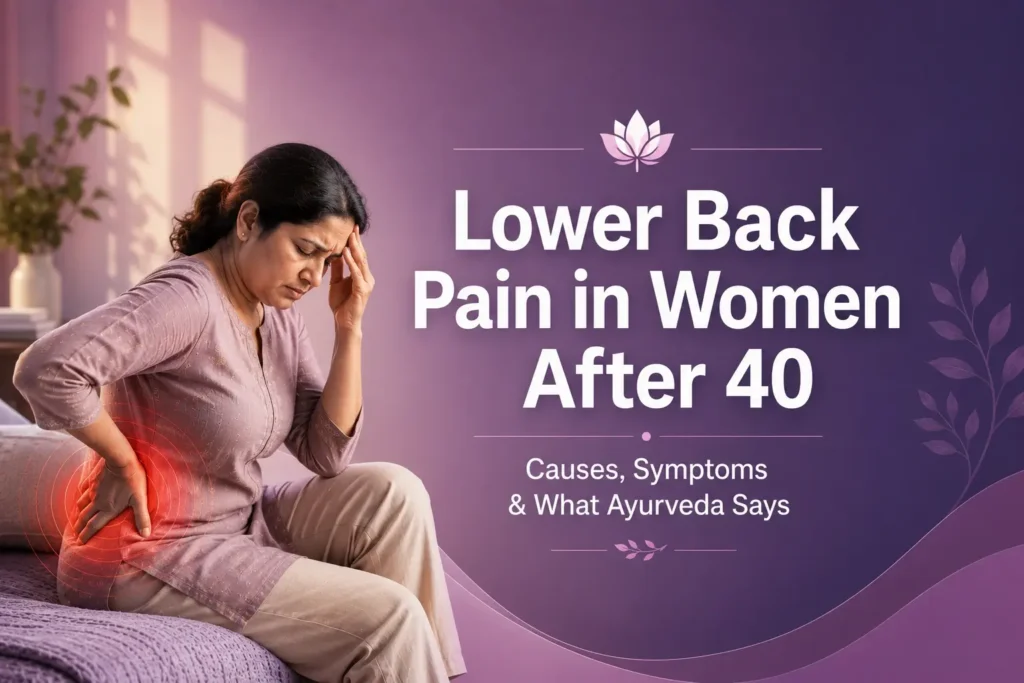
Lower back pain is common in women after 40 due to hormonal changes, muscle weakness, age-related wear and tear, poor posture, prolonged sitting, and conditions like osteoarthritis. Ayurveda associates persistent lower back pain with Kati Shoola and aggravated Vata Dosha, recommending lifestyle changes, regular movement, oil massage, and holistic care to support long-term back health.
She wakes up. Same lower back pain. Not from lifting something. Not from a fall. Just — there. Like it lives there now.
If you are a woman over 40, or you are reading this for your mother or wife — this pain is not in her head. It is not just ageing. And it is definitely not something she simply has to learn to live with.
Many women start experiencing lower back pain around this stage of life. While it’s tempting to dismiss it as “just ageing,” that’s not the complete picture. Several changes happen inside the body after 40, and understanding them can help you manage your back pain more effectively.
This article explains exactly what is happening, what Ayurveda has known about it for centuries, and what actually helps.
In this article:
- 1. The number that explains everything
- 2. What falling estrogen actually does to your lower back
- 3. Why Lower Back Pain Can Be More Challenging for Many Indian Women
- 4. 7 Common Causes of Lower Back Pain in Women After 40
- 5. Could an Underlying Medical Condition Be Responsible?
- 6. What Ayurveda calls this — and why it makes total sense
- 7. Temporary Relief vs Long-Term Support
- 8. What actually helps — practical Ayurvedic relief
- 9. Final Thoughts
- 10. FAQs
The number that explains everything
Here is something most women over 40 do not know — and it changes everything.
Studies show that 34% to 83% of women going through perimenopause experience lower back pain. Not occasionally. Regularly. It is one of the most common symptoms of perimenopause — and one of the least talked about.
And here is the part that matters specifically for Indian women:
The average age of menopause in Indian women is around 46 years — nearly 5 years earlier than the global average of 51. This means perimenopause — the phase leading up to menopause — begins in the early 40s for most Indian women.
So when a 42-year-old Indian woman starts feeling a persistent lower backache — it is not early. It is exactly on time. Her body is going through something real. Something hormonal. And something that Ayurveda understood long before modern medicine gave it a name.
What Falling Estrogen Actually Does to Your Lower Back
Most people think estrogen is only about periods and pregnancy. It is not.
Estrogen actively protects your bones, spinal discs, and the ligaments that hold your spine together. When it starts falling — usually from the early 40s onwards — your lower back is one of the first places to feel it.
Here is what actually happens:
Bone loss in the spine
Women lose up to 20% of their bone mineral density in the 5 to 7 years around menopause — and the vertebrae in the lower back are directly affected. Weaker bones mean a spine that hurts more easily and heals more slowly.
Discs drying out
The cushioning pads between your spinal bones — called intervertebral discs — are mostly water. Estrogen helps keep them hydrated. When estrogen falls, these discs dry out, lose their height and become less effective shock absorbers. Every step, every bend, every twist — felt more directly.
Ligaments loosening
Estrogen keeps spinal ligaments firm. When it fluctuates, those ligaments loosen — making the lower back unstable and more vulnerable to mechanical pain, especially during prolonged standing or cooking.
Pain sensitivity turning up
Estrogen also regulates serotonin and endorphins — the body’s natural pain dampeners. When estrogen crashes, the spinal cord effectively turns up the volume on pain signals. Normal aches feel worse than they should. This is not weakness. This is biology. All four of these things often happen at the same time. That is why the lower back pain at 42 can feel so sudden, so persistent and so different from any pain felt before.
A recent systematic review and meta-analysis involving more than 93,000 women found that lower back pain was more common during perimenopause and postmenopause than before menopause, highlighting the important role hormonal changes may play in back discomfort. However, hormones are rarely the only factor, and lifestyle, posture, muscle strength, and age-related changes also contribute
Why Lower Back Pain Can Be More Challenging for Many Indian Women
Hormonal changes are only one part of the story.
For many Indian women, lower back pain doesn’t begin because of one bad movement or a single medical condition. It develops gradually—over years of carrying responsibilities that rarely pause.
Many women don’t experience more pain because they’re weak.
They experience more pain because they rarely get the chance to recover.
While the body is already adapting to age-related changes such as declining estrogen, everyday life continues at the same pace. Meals still need to be cooked. Floors still need to be cleaned. Children, parents, and families still need care.
The body changes—but the workload often doesn’t.
1) The physical demands of daily life are real
For many women, the day begins before everyone else wakes up and ends after everyone has gone to bed.
Between cooking, sweeping, mopping, washing clothes, lifting buckets, carrying groceries, and caring for children or elderly family members, the lower back is constantly working.
Each activity may seem small on its own.
Together, repeated day after day for years, they place a considerable load on the muscles, joints, and spine.
2) Everyday movements add up over time
In many Indian households, daily life still involves frequent bending, squatting, sitting close to the floor, or getting up repeatedly during household chores and prayers.
These movements aren’t harmful by themselves.
But when they’re performed repeatedly on muscles and joints that have become less resilient with age, they can make existing back pain more noticeable.
3) Nutrition also plays an important role
Vitamin D deficiency is common in India, even in regions with abundant sunlight. Combined with inadequate calcium intake, it can affect bone and muscle health—especially after menopause, when estrogen levels naturally decline.
That’s why maintaining adequate nutrition is just as important as staying physically active.
4) The biggest problem isn’t always the pain—it’s ignoring it
Perhaps the most heartbreaking part is that many women don’t seek help when the pain first appears.
They tell themselves:
- “It’s just because I’m getting older.”
- “Everyone has back pain.”
- “I’ll rest once the work is finished.”
But the work rarely finishes.
Weeks become months.
Months become years.
The pain slowly becomes part of everyday life.
The pain was not imaginary. It was just consistently ignored—by everyone around her, and often by herself.
If your lower back has been hurting for weeks or months, don’t assume it’s simply something you have to live with. Pain is your body’s way of asking for attention. Understanding the cause early and taking timely steps—whether through medical advice, physiotherapy, exercise, or supportive Ayurvedic care—can make a meaningful difference.
7 Common Causes of Lower Back Pain in Women After 40
1. Weak Core and Back Muscles
As we grow older, muscle mass naturally declines unless we stay physically active.
Weak core muscles provide less support to the spine, forcing the lower back to work harder during everyday movements.
2. Poor Posture
Many women unknowingly place extra stress on their spine by:
- Slouching while sitting
- Looking down at mobile phones
- Bending incorrectly while cleaning
- Standing unevenly for long periods
Small posture habits repeated every day can contribute significantly to chronic back pain.
3. Sitting for Long Hours
Whether you’re working from home, driving, or watching television, sitting continuously compresses the structures of the lower back.
Taking a short walk every 30–60 minutes can help reduce prolonged strain.
4. Weight Gain
Extra body weight increases the load placed on the spine and surrounding muscles.
Over time, this additional pressure can contribute to persistent lower back discomfort.
5. Age-Related Wear and Tear
The discs between the spinal bones gradually lose water content and flexibility with age.
This natural process can reduce shock absorption and make certain movements feel painful or stiff.
6. Osteoarthritis
Wear and tear in the joints of the spine can lead to osteoarthritis.
Symptoms often include:
- Morning stiffness
- Pain after activity
- Reduced flexibility
- Difficulty standing for long periods
7. Stress and Muscle Tension
Emotional stress often shows up physically.
When you’re stressed, muscles around the neck, shoulders, and lower back tend to tighten.
Over weeks or months, this constant tension may contribute to ongoing pain.
Could an Underlying Medical Condition Be Responsible?
Most lower back pain improves with lifestyle changes, exercise, and appropriate treatment.
However, persistent pain can sometimes be linked to an underlying medical condition.
Here are a few possibilities.
Endometriosis
Although endometriosis is most common during the reproductive years, some women continue to experience symptoms into their 40s, especially before menopause.
In addition to pelvic pain, it may also cause:
- Lower back pain
- Pain during menstruation
- Pain during intercourse
- Heavy menstrual bleeding
According to the WHO, endometriosis affects approximately 10% of women and girls of reproductive age worldwide.
Fibromyalgia
Fibromyalgia is a chronic condition that causes widespread pain throughout the body.
Women are diagnosed with fibromyalgia more often than men, and symptoms may become more noticeable during midlife.
Besides lower back pain, people with fibromyalgia often experience:
- Pain in multiple areas of the body
- Fatigue
- Poor sleep
- Morning stiffness
- Difficulty concentrating (“brain fog”)
If your pain is widespread rather than limited to your lower back, speak with your healthcare provider for a proper evaluation.
Symptoms You Should Never Ignore
Most cases of lower back pain improve with time, movement, and proper care. However, some symptoms should never be ignored because they may indicate a more serious condition.
Consult a doctor immediately if you experience:
- Pain that shoots down one or both legs
- Numbness or tingling in the legs or feet
- Loss of bladder or bowel control
- Severe pain after a fall or accident
- Fever along with back pain
- Unexplained weight loss
- Pain that wakes you up every night
- Pain that doesn’t improve after 4–6 weeks despite self-care
Getting an early diagnosis can prevent complications and help you receive the right treatment.
What Ayurveda Calls This — And Why It Makes Total Sense
Ayurveda has a name for lower back pain — Katishoola. Kati means lower back. Shoola means pain.
The Charaka Samhita describes Katishoola as a disorder of Apana Vata — the downward-moving sub-type of Vata dosha that governs the pelvic region, lower back and reproductive organs.
Here is why this is fascinating — and why it lines up exactly with modern science:
What modern medicine says: Falling estrogen levels deplete tissue, dry out discs, and weaken the spine.
What Ayurveda says: Aggravated Apana Vata causes dryness, depletion and weakness in the pelvic and lower back region.
Different language. Same observation. Five thousand years apart.
In Ayurveda, women in their 40s are entering what is called the Vata phase of life — the third stage after childhood (Kapha) and adulthood (Pitta). This is when Vata naturally increases in the body. Combined with the hormonal shifts of perimenopause — which in Ayurvedic terms further aggravate Apana Vata — the lower back becomes one of the most vulnerable areas in the body.
The Ayurvedic solution is not to suppress the pain. It is to restore what has been depleted — oleation, warmth and nourishment — directly to the affected tissue. This is precisely why Abhyanga (warm medicated oil massage) has been prescribed for Katishoola in Ayurvedic texts for centuries.
As we discussed in detail in our article on why pain gets worse at rest — Vata aggravation follows a very consistent pattern. And the treatment — warm, deep-penetrating medicated oil — is consistent across all Vata conditions.
Temporary Relief vs Long-Term Support
Many people treat lower back pain only when it becomes unbearable.
They take a painkiller, apply an oil for a few days, feel better, and then stop.
When the pain returns, the cycle repeats.
That’s why it’s important to think beyond temporary relief.
Long-term improvement usually comes from a combination of:
- Understanding the underlying cause
- Staying physically active
- Maintaining healthy posture
- Strengthening supporting muscles
- Following consistent self-care habits
If you’ve ever wondered why pain seems to improve for a while and then comes back, you may find our guide on “Why Does Pain Keep Coming Back?“ helpful.
What Actually Helps — Practical Ayurvedic Relief
Here is the honest answer — there is no single thing that fixes this overnight. But some things consistently work when done together and done regularly.
1. Warm medicated oil massage
This is the most important one. A randomised controlled trial published in PubMed found that Ayurvedic massage with medicated oil significantly reduced chronic lower back pain — with patients reporting pain reduction from 5/10 to 1/10 after a 5-day course.
Apply warm Ayurvedic medicated oil to the lower back and sacral region. Massage gently in circular strokes for 5 minutes. Do this before your morning bath and again before sleeping. The warmth directly counters Vata dryness. The medicated ingredients go into the tissue — not just sit on the skin.
2. Eat to support your bones and tissue
Small changes that make a real difference:
- Add sesame seeds (til) to your diet — highest plant-based calcium source
- Warm turmeric milk at night — anti-inflammatory and Vata-pacifying
- Soaked almonds in the morning — support bone and nerve health
- Reduce cold foods, iced drinks and raw salads in the evening — all of these aggravate Vata
- Get your Vitamin D levels tested — supplement if deficient
3. Move gently — do not rest completely
Complete rest worsens Vata. Gentle movement is medicine. Try these every morning — 10 minutes is enough:
- Cat-cow stretch — relieves lumbar compression immediately
- Pelvic tilt — strengthens core support for the lower back
- Supine knee hug — releases the lower back and sacrum gently
- Slow walking for 15 minutes — keeps Vata moving and circulation active
4. Be consistent — not occasional
This is where most people go wrong. They apply oil twice, feel slightly better, stop. Then the pain comes back and they conclude it did not work.
Many people treat lower back pain only when it becomes unbearable.
As we explained in our article on why pain relief oils stop working over time — healing is a progressive process. Twice-daily, consistent Ayurvedic oil application allows the active compounds to build up in the tissue. The improvement is real — but it happens over 2 to 4 weeks, not 2 to 4 applications.
Dr PainQo works beyond surface relief — its formulation is specifically designed to reach the tissue level where Apana Vata depletion lives, not just create a surface sensation that fades within hours.
“The women I see most often are those who have been carrying this pain for 3, 4, sometimes 5 years before they come in. They assumed it was just part of getting older. Or part of being a mother. Or that they were being dramatic. They were not. What they were living with was a real, specific, treatable condition — Apana Vata depletion — that Ayurveda has a very clear answer for. The tragedy is how long they waited to ask for help.”
— Dr Aesha Nanal, BAMS, MD, MBA (Ayurvedic Pharmacy) | Lead Formulator, Dr PainQo
A Final Thought
Lower back pain after 40 is common—but it isn’t something you simply have to accept.
Whether your pain is linked to hormonal changes, muscle weakness, poor posture, or age-related wear and tear, understanding the cause is the first step toward finding lasting relief.
Small, consistent changes—regular movement, good nutrition, posture correction, and supportive Ayurvedic care—often make a bigger difference than quick fixes used only when the pain becomes unbearable.
💡 You Have Carried Enough.
Your back has been asking for help for a long time. Give it something that actually heals.
FAQs
Yes, in most cases. Gentle walking helps improve blood circulation, reduces stiffness, and strengthens the muscles that support your spine. However, if walking makes your pain significantly worse or you experience numbness or pain shooting down your leg, consult a doctor.
There isn’t a single “best” treatment. A combination of regular movement, posture correction, strengthening exercises, maintaining a healthy weight, and consistent Ayurvedic practices such as warm medicated oil massage (Abhyanga) can help support long-term back health.
Most people with lower back pain don’t need a scan immediately. If your doctor suspects a slipped disc, nerve compression, or another serious condition, an MRI is usually the preferred imaging test. X-rays are mainly useful for evaluating bones and fractures.
There is no instant cure for lower back pain. The fastest improvement usually comes from identifying the underlying cause and combining appropriate treatment with gentle movement, posture correction, and consistent self-care. If the pain is severe, persistent, or accompanied by warning signs, seek medical evaluation promptly.
